Learn which FHA loan documents you’ll need before applying, including income, employment, bank statements, tax returns, and more.
Applying for an FHA loan is an exciting step toward homeownership, but before your lender can approve your mortgage, you’ll need to provide documentation that verifies your financial situation. Having the right FHA loan documents ready before you apply can help streamline the process, reduce delays, and keep your application moving forward.
Many homebuyers are surprised by how much paperwork is involved in a mortgage application. In addition to verifying your identity, lenders will review documents related to your income, employment, assets, debts, and other financial information to determine whether you meet the FHA loan requirements.
The good news is that most of these documents are ones you likely already have or can easily obtain. The key is knowing exactly what you’ll need before your lender asks for it. Being prepared can save time, reduce stress, and help you avoid last-minute requests that could slow down your closing.
In this guide, we’ll walk through the FHA loan documents you’ll typically need before applying, explain why each document is important, share tips for organizing your paperwork, and highlight common documentation mistakes that can delay your mortgage approval.
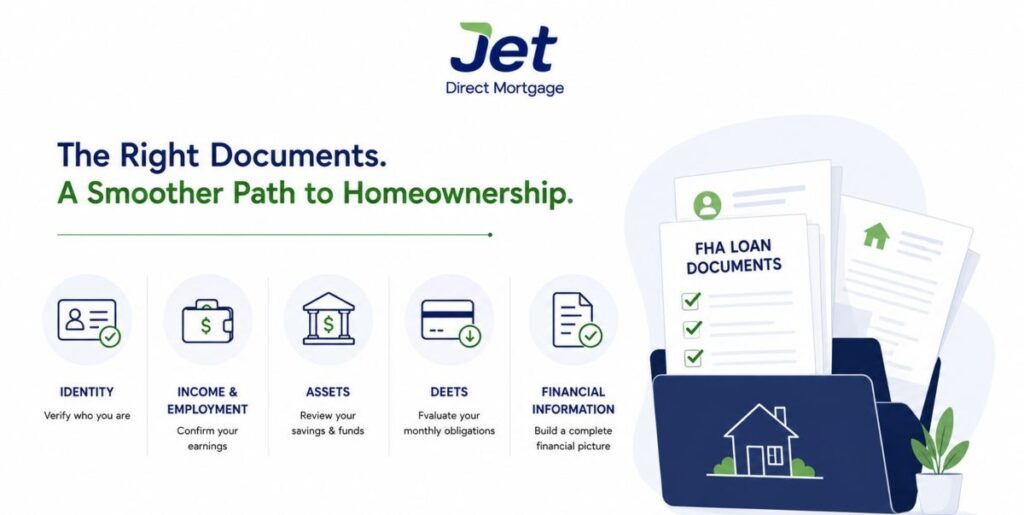
Why Do FHA Loan Documents Matter?
Before approving your mortgage, lenders need to verify that the information on your application is accurate and that you meet the FHA loan requirements. That’s why gathering the right FHA loan documents is one of the most important steps in the homebuying process.
Each document serves a specific purpose.
Some verify your identity, while others confirm your income, employment, available assets, or existing financial obligations. Together, they help your lender build a complete picture of your financial profile and determine whether you qualify for an FHA loan.
Having your paperwork organized before you apply offers several advantages:
- It can help speed up the mortgage approval process.
- It reduces the likelihood of last-minute document requests.
- It allows your lender to identify potential issues earlier.
- It helps keep your application moving through underwriting more efficiently.
- It can reduce unnecessary stress as you get closer to closing.
It’s also important to remember that every borrower is different. Depending on your employment, income sources, or financial situation, your lender may request additional documentation beyond the standard requirements.
In the next section, our team at Jet Direct Mortgage will walk you through the 12 most common FHA loan documents you’ll typically need before applying, explain why each one is required, and share tips to help you prepare them in advance.
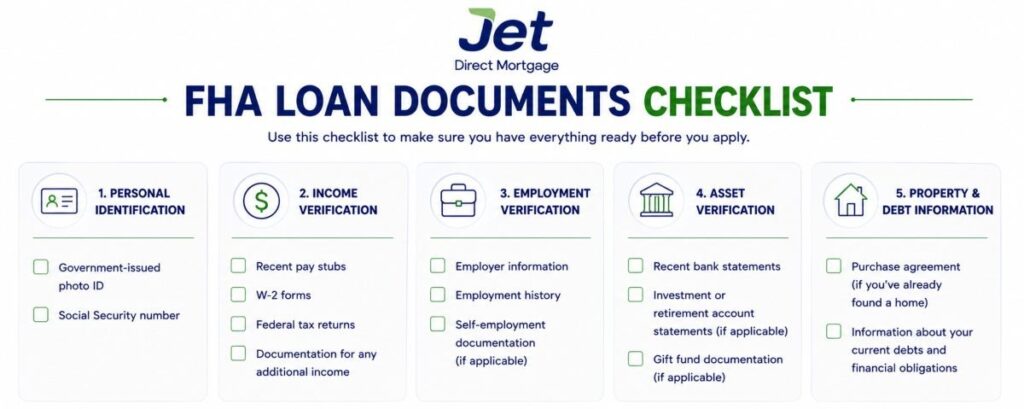
FHA Loan Documents Checklist
Before applying for an FHA loan, it’s a good idea to gather your paperwork in advance. While your lender may request additional documents depending on your situation, most borrowers will need the following FHA loan documents during the mortgage application process.
Use this checklist to make sure you have everything ready before you apply.
Personal Identification
☐ Government-issued photo ID
☐ Social Security number
Income Verification
☐ Recent pay stubs
☐ W-2 forms
☐ Federal tax returns
☐ Documentation for any additional income
Employment Verification
☐ Employer information
☐ Employment history
☐ Self-employment documentation (if applicable)
Asset Verification
☐ Recent bank statements
☐ Investment or retirement account statements (if applicable)
☐ Gift fund documentation (if applicable)
Property & Debt Information
☐ Purchase agreement (if you’ve already found a home)
☐ Information about your current debts and financial obligations
Having these FHA loan documents organized before you begin the application process can help reduce delays, minimize additional document requests, and keep your mortgage moving forward more efficiently.
In the next section, we’ll explain each document in more detail, why your lender needs it, and how you can prepare it before applying.
12 FHA Loan Documents Explained
1. Government-Issued Photo ID
One of the first FHA loan documents you’ll be asked to provide is a valid government-issued photo ID. Before approving your mortgage, your lender must verify your identity to ensure the information on your application matches your financial records and credit history.
In most cases, you’ll only need one current, unexpired form of identification. Commonly accepted documents include:
- Driver’s license
- State-issued identification card
- U.S. passport
- Permanent Resident Card (if applicable)
If there are multiple borrowers applying for the mortgage, each applicant will need to provide their own photo ID. Your photo ID allows your lender to verify your identity, confirm your legal name and date of birth, and match your application to your credit and financial records.
Quick Tip
Before applying, check that your ID is current, unexpired, and clearly legible. If you’ve recently changed your name due to marriage, divorce, or another legal reason, let your lender know early in the process and be prepared to provide supporting legal documentation.
Taking care of these details beforehand can help prevent unnecessary delays with your FHA loan application.
2. Social Security Number
Another important FHA loan document you’ll need when applying for a mortgage is your Social Security number (SSN). Your lender uses this information to verify your identity, obtain your credit report, and review your financial history as part of the underwriting process.
If you’re applying with a co-borrower, each applicant will generally need to provide their own Social Security number.
Quick Tip
Before submitting your mortgage application, make sure the personal information on your application, including your full legal name, Social Security number, and date of birth, is accurate and consistent across all of your FHA loan documents. Even small discrepancies can result in additional verification requests and unnecessary delays during underwriting.
3. Recent Pay Stubs
Your recent pay stubs are among the most important FHA loan documents because they give your lender a snapshot of your current income and employment. Even if you’ve already provided W-2s or tax returns, pay stubs help verify that you’re still employed and earning the income listed on your mortgage application.
In most cases, lenders will ask for your most recent 30 days of pay stubs, although the exact timeframe may vary depending on your employment situation.
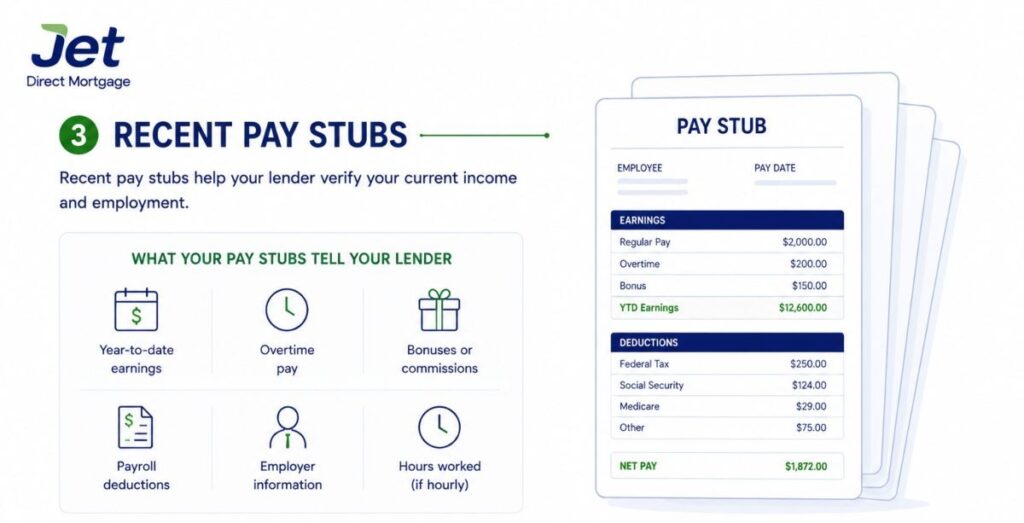
What Your Pay Stubs Tell Your Lender
Your pay stubs provide much more than your salary. They can also show:
- Year-to-date earnings
- Overtime pay
- Bonuses or commissions
- Payroll deductions
- Employer information
- Hours worked (if you’re paid hourly)
This information helps your lender determine whether your income is stable and can be used to qualify for an FHA loan.
If Your Income Isn’t the Same Every Month
Don’t worry if your paycheck changes from one pay period to the next. Many borrowers receive overtime, commissions, bonuses, or work variable hours.
If your income fluctuates, your lender may request additional documentation to understand your earnings over a longer period. This doesn’t necessarily prevent you from qualifying, it simply allows the lender to calculate your income more accurately.
The more complete and up to date your FHA loan documents are, the easier it is for your lender to verify your income and keep your mortgage application moving forward.
4. W-2 Forms
If you’re a W-2 employee, your lender will typically ask for your W-2 forms from the past two years as part of your FHA loan documents. These forms provide a record of your annual earnings and help verify that the income reported on your mortgage application is accurate.
Unlike your recent pay stubs, which show your current earnings, W-2s allow your lender to review your income over a longer period and identify any significant changes or trends.
- Confirm your annual income
- Verify your employment history
- Compare your earnings from year to year
- Cross-reference your tax returns and pay stubs
- Calculate your qualifying income more accurately
For example, if your pay increased because of a promotion or decreased because you changed jobs, your W-2s help provide context and support the rest of your financial documentation.
If you don’t receive W-2s because you’re self-employed or earn 1099 income, don’t worry. You’ll simply provide different FHA loan documents, such as tax returns and additional business documentation, which we’ll discuss later in this guide.
Quick Tip Before You Apply
Take a few minutes to locate your W-2 forms before starting your mortgage application. Having them readily available can help your lender verify your income more quickly and reduce the chances of additional documentation requests during underwriting.
5. Federal Tax Returns
Your federal tax returns are another key part of your FHA loan documents because they provide a broader picture of your financial history than a single paycheck or W-2. Lenders use them to verify your income, identify additional sources of earnings, and evaluate the consistency of your finances over time.
Most lenders will request your federal tax returns from the previous two years, although additional years may be required in certain situations, particularly if you’re self-employed or have more complex income.
What Can Lenders Verify From Your Tax Returns?
| Information | Why It Matters |
| Employment income | Confirms your reported earnings. |
| Self-employment income | Verifies business income and expenses. |
| Rental income | May help support your qualifying income. |
| Investment income | Shows dividends, interest, or capital gains. |
| Other income sources | Helps provide a complete financial picture. |
Because tax returns include much more detail than other FHA loan documents, it’s important that the information matches the rest of your application. If there are significant changes in your income from one year to the next, your lender may simply ask for additional context or supporting documentation.
What If You Haven’t Filed Your Taxes Yet?
If you’ve recently received an extension or haven’t filed your most recent tax return, let your lender know as early as possible. They can explain what additional documentation may be needed and whether it could affect your FHA loan application.
Preparing your tax returns in advance is one of the easiest ways to help your lender verify your financial information and keep your mortgage process moving efficiently.
6. Bank Statements
Your bank statements are one of the most closely reviewed FHA loan documents because they help your lender verify that you have enough funds available to complete your home purchase.
Most lenders will ask for your most recent two months of bank statements for the accounts you’ll use during the transaction. These statements provide a snapshot of your financial activity and help confirm that the funds you’re planning to use are available and properly documented.
What Lenders Look For
When reviewing your bank statements, lenders typically pay attention to:
- Your available account balances
- Consistent savings patterns
- Funds available for your down payment and closing costs
- Large or unusual deposits
- Signs of undisclosed debt or financial obligations
Don’t worry if your account activity isn’t perfect—lenders understand that everyone’s finances are different. Their goal is simply to verify where your funds came from and ensure there aren’t any unexpected risks.
Watch Out for Large Deposits
One of the most common reasons lenders ask follow-up questions is because of a large deposit that can’t easily be explained.
For example, if you recently sold a vehicle, received a financial gift from a family member, or transferred money from another account, your lender may ask for supporting documentation showing the source of those funds.
Having that documentation ready can help prevent unnecessary delays during underwriting.
Pro Tip
Before applying for an FHA loan, avoid moving large amounts of money between accounts unless necessary. Keeping your finances as consistent as possible, and maintaining clear records of any significant transactions, can make it much easier for your lender to review your FHA loan documents and keep your application moving forward.
7. Employment Verification
Providing proof of employment is another important part of your FHA loan documents. While your pay stubs and W-2s show what you’ve earned, employment verification confirms that you’re currently employed and that your income is expected to continue.
Depending on your situation, your lender may verify your employment in several ways. This often includes contacting your employer directly or using a third-party employment verification service shortly before your loan closes.
How Employment Is Typically Verified
| Employment Type | Common Verification Method |
| Full-time employee | Employer verification and recent pay stubs |
| Part-time employee | Employer verification and income history |
| Self-employed | Tax returns and business documentation |
| Retired | Pension, retirement, or Social Security documentation |
It’s important to remember that employment verification doesn’t stop once you’re pre-approved. Many lenders perform a final verification just days before closing to confirm that your employment status hasn’t changed.
Avoid Job Changes During the Mortgage Process
Changing jobs while your loan is being processed doesn’t automatically mean your mortgage will be denied, but it can require additional documentation and may delay underwriting.
If you’re considering changing employers, switching from a salaried position to commission-based income, or becoming self-employed, it’s a good idea to discuss your plans with your mortgage banker before making the transition.
Keeping your employment stable throughout the mortgage process is one of the simplest ways to help your FHA loan documents move through underwriting without unnecessary complications.
8. Proof of Additional Income
If you receive income beyond your regular paycheck, you’ll likely need to include documentation for it as part of your FHA loan documents. While this income isn’t required to qualify for an FHA loan, documenting it may strengthen your application and increase your qualifying income if it meets FHA guidelines.
Additional income must generally be consistent, well-documented, and expected to continue in the future.
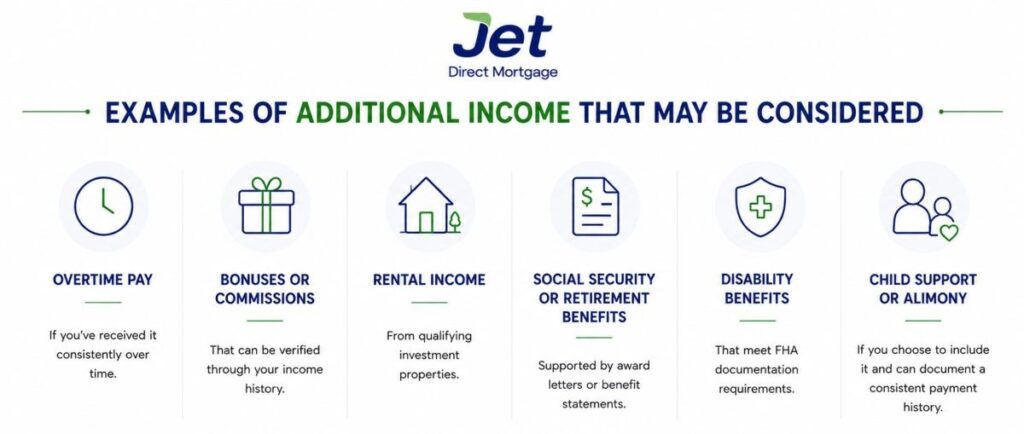
Examples of Additional Income That May Be Considered
- Overtime pay if you’ve received it consistently over time.
- Bonuses or commissions that can be verified through your income history.
- Rental income from qualifying investment properties.
- Social Security or retirement benefits supported by award letters or benefit statements.
- Disability benefits that meet FHA documentation requirements.
- Child support or alimony, if you choose to include it and can document a consistent payment history.
Not every source of income automatically qualifies, and documentation requirements vary depending on the type of income you’re receiving.
Supporting Documents May Include
Depending on the income source, your lender may request:
- Award or benefit letters
- Pension or retirement statements
- Lease agreements
- Deposit history shown on your bank statements
- Tax returns
- Additional employer documentation
If you’re unsure whether a particular source of income can be used, discuss it with your mortgage banker before applying.
Providing the appropriate FHA loan documents upfront can help your lender determine which income sources may be included when evaluating your mortgage application.
9. Asset Documentation
In addition to verifying your income, your lender will also want to confirm that you have the financial resources needed to complete your home purchase. That’s why asset documentation is an important part of your FHA loan documents.
Assets are any financial resources you own that may be used during the mortgage process. These documents help your lender verify that your funds are available, properly sourced, and sufficient to cover your down payment, closing costs, and any other required expenses.
Depending on your financial situation, you may be asked to provide documentation for:
- Checking and savings accounts
- Money market accounts
- Certificates of deposit (CDs)
- Retirement accounts, such as 401(k)s or IRAs
- Investment or brokerage accounts
- Stocks, bonds, or mutual funds
- Other liquid assets that may be used to complete your home purchase
Keep in mind that not all assets will necessarily be used to qualify for your mortgage. In many cases, your lender simply wants to verify that the funds shown on your application are legitimate and readily available if needed.
If you’re planning to use money from an investment account or retirement fund, let your mortgage banker know early in the process. Depending on the type of account, additional documentation may be required to verify ownership, determine the accessible balance, or confirm that the funds can be used for your home purchase.
Having your asset documentation organized alongside the rest of your FHA loan documents can help reduce additional requests during underwriting and keep your mortgage application moving efficiently.
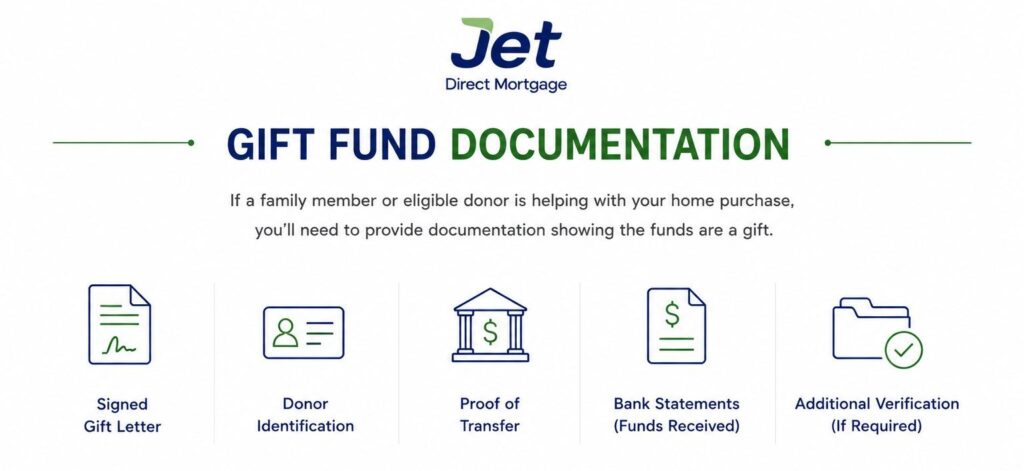
10. Gift Fund Documentation
If a family member or another eligible donor is helping you purchase your home, you’ll need to include gift fund documentation as part of your FHA loan documents. FHA guidelines allow qualified gift funds to be used toward your down payment, closing costs, and other eligible homebuying expenses, provided the funds are properly documented.
Gift funds can make homeownership more attainable, especially if you’ve saved for your purchase but could use additional financial assistance to complete the transaction.
Depending on your situation, your lender may request:
- A signed gift letter stating that the funds are a gift and do not need to be repaid.
- Documentation identifying the donor.
- Proof that the gift funds were transferred.
- Bank statements showing the funds were received.
- Additional documentation verifying the source of the gift, if required.
It’s important to remember that not everyone can provide gift funds under FHA guidelines. Eligible donors generally include close family members, domestic partners, employers, labor unions, charitable organizations, and certain government homeownership assistance programs.
To avoid delays, let your mortgage banker know as early as possible if you plan to use gift funds. Preparing the necessary FHA loan documents before applying can help ensure the funds are properly documented and accepted during underwriting.
11. Information About Your Existing Debts
As part of your FHA loan documents, your lender will review your current financial obligations to better understand how a new mortgage fits into your overall budget. While much of this information can be obtained through your credit report, you may still be asked to provide documentation for certain debts or explain specific financial obligations.
Your lender may review debts such as:
- Auto loans
- Student loans
- Credit cards
- Personal loans
- Child support or alimony
- Existing mortgages or home equity loans
- Other recurring monthly obligations
This information is used to calculate your debt-to-income ratio (DTI), one of the key factors lenders consider when determining whether you qualify for an FHA loan.
If you’ve recently paid off a loan, settled a debt, or no longer have an obligation that still appears on your credit report, be prepared to provide supporting documentation. Keeping records of loan payoff statements or account closures can help your lender verify the information and avoid unnecessary delays.
Before applying, it’s also a good idea to review your credit report to make sure your listed debts are accurate. Identifying and correcting any errors ahead of time can make the underwriting process smoother and ensure your FHA loan documents reflect your current financial situation.
12. Purchase Agreement
Once you’ve found a home and your offer has been accepted, one of the final FHA loan documents your lender will need is a fully executed purchase agreement.
This document outlines the terms and conditions of the home purchase and serves as the foundation for moving your mortgage application into processing and underwriting.
The purchase agreement typically includes important details such as:
- The agreed purchase price
- The property address
- The names of the buyer and seller
- The proposed closing date
- Any negotiated seller concessions or credits
- Contingencies related to financing, inspections, or the appraisal
Your lender uses this information to verify that the loan amount aligns with the property’s value and to begin ordering the FHA appraisal and other required services. It also helps determine the final loan terms and ensures that all parties are working toward the same closing timeline.
If any changes are made after the contract is signed, such as a revised purchase price, updated closing date, or negotiated repair credits, be sure to notify your mortgage banker as soon as possible.
Updated agreements or amendments may need to be added to your FHA loan documents to avoid delays during underwriting and help keep your mortgage on track.
Conclusion: Get Your FHA Loan Documents Ready Before You Apply
Preparing your FHA loan documents before you begin the mortgage application process is one of the simplest ways to save time, reduce stress, and avoid unnecessary delays.
From verifying your identity and income to documenting your assets and employment, each document plays an important role in helping your lender evaluate your eligibility and move your loan toward approval.
While every borrower’s situation is different, having your paperwork organized in advance allows your mortgage banker to review your application more efficiently and identify any additional documentation that may be needed early in the process. The better prepared you are, the smoother your homebuying journey is likely to be.
At Jet Direct Mortgage, we help homebuyers understand exactly which FHA loan documents they need before applying. Our experienced team will walk you through every step of the process, answer your questions, and make sure you have everything required to keep your mortgage moving forward.
If you’re ready to apply for an FHA loan or would like help preparing your documentation, contact Jet Direct Mortgage today. We’ll help you gather the right paperwork and guide you from application to closing.
Frequently Asked Questions
What FHA loan documents do I need to apply?
Most borrowers will need a government-issued photo ID, Social Security number, recent pay stubs, W-2 forms, federal tax returns, bank statements, employment verification, asset documentation, and information about their existing debts.
Depending on your financial situation, your lender may request additional FHA loan documents.
How many bank statements are required for an FHA loan?
Most lenders request your two most recent bank statements for the accounts you’ll use during the home purchase. Additional statements may be required if there are large deposits or other transactions that need further documentation.
Do I need tax returns for an FHA loan?
Yes. Most lenders ask for your federal tax returns from the previous two years to verify your income and review your financial history. Self-employed borrowers may need to provide additional tax documentation.
What documents do self-employed borrowers need?
In addition to the standard FHA loan documents, self-employed borrowers may need business tax returns, profit and loss statements, business bank statements, and other records that verify their income.
Can I use digital copies of my FHA loan documents?
In many cases, yes. Most lenders accept clear digital copies of documents submitted through secure online portals. Your mortgage banker will let you know if original documents are required for any part of the process.
Do I need employment verification if I already provide pay stubs?
Yes. Pay stubs show your current income, but lenders may also verify your employment directly with your employer or through a third-party verification service before closing.
Can gift funds be used for an FHA loan?
Yes. Eligible gift funds may be used toward your down payment or closing costs, provided they meet FHA guidelines and are properly documented with the required gift letter and supporting records.
What happens if I’m missing one of my FHA loan documents?
Don’t panic. Missing documentation doesn’t necessarily prevent you from qualifying for an FHA loan, but it can delay underwriting. Your mortgage banker will explain what’s needed and help you obtain any missing paperwork.
When should I start gathering my FHA loan documents?
Ideally, you should begin organizing your FHA loan documents before you apply for pre-approval. Having everything ready ahead of time can help speed up the approval process and reduce last-minute requests.
How can Jet Direct Mortgage help with my FHA loan documents?
The team at Jet Direct Mortgage will explain exactly which FHA loan documents you’ll need based on your financial situation, review your paperwork before you apply, and help ensure your application is as complete and organized as possible. Our goal is to make the FHA loan process as smooth and efficient as possible from start to finish.

Experienced Chief Operating Officer with a 26 + year demonstrated history of working in the banking industry. Skilled in all aspects of the residential mortgage market . Strong business development professional with a Bachelor of Science (BS) focused in Business Administration and Management, from St. Joseph College. A direct endorsement underwriter and a licensed Mortgage Loan Originator.