
Access Your Home Equity. Stay in the Home You Love.
If you’re considering a HECM mortgage in New York, you’re likely looking for a way to access the equity you’ve built in your home while continuing to live there throughout retirement.
For many homeowners, a Home Equity Conversion Mortgage (HECM) can provide greater financial flexibility without requiring the monthly mortgage payments associated with a traditional home loan.
As the most common type of FHA-insured reverse mortgage, a HECM is designed specifically for homeowners aged 62 and older who want to convert a portion of their home equity into available funds.
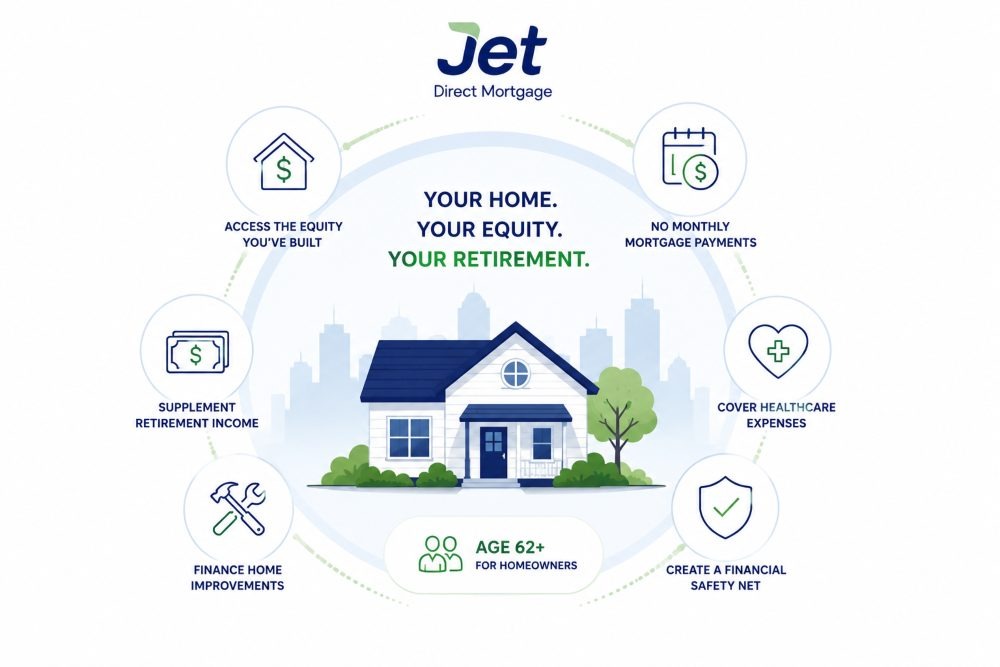
Whether you’re hoping to supplement your retirement income, pay off an existing mortgage, cover healthcare expenses, finance home improvements, or simply create a financial safety net, a HECM mortgage may be worth exploring.
Ready to Start the HECM Mortgage Process?
At Jet Direct Mortgage, we believe informed homeowners make better financial decisions. That’s why we’ve created this comprehensive guide; to explain how a HECM mortgage in New York works, answer the most common questions homeowners have, and help you decide whether a Home Equity Conversion Mortgage is the right solution for your retirement and homeownership goals.
What Is a HECM Mortgage in New York?
A HECM mortgage in New York, or Home Equity Conversion Mortgage, is a federally insured reverse mortgage that allows eligible homeowners aged 62 and older to convert a portion of the equity in their home into available funds while continuing to live in the property.
The program is insured by the Federal Housing Administration (FHA) and is the most widely used reverse mortgage program in the United States.
Unlike a traditional mortgage, where you make monthly payments to gradually reduce your loan balance, a HECM mortgage works in the opposite way. Instead of paying the lender each month, you receive funds based on the equity you’ve built in your home. Depending on your financial goals, these funds can be received as a lump sum, monthly payments, a line of credit, or a combination of payment options.
One of the biggest misconceptions about a HECM mortgage in New York is that the lender takes ownership of your home. In reality, you remain the homeowner throughout the life of the loan.
As long as you continue to meet the loan requirements, including living in the property as your primary residence, maintaining the home, and paying property taxes and homeowners insurance. you retain the title and all the rights associated with homeownership.
The amount you can borrow isn’t based solely on your home’s value. Lenders also consider factors such as:
- Your age (or the age of the youngest borrower)
- Your home’s appraised value
- Current interest rates
- The outstanding balance of any existing mortgage
- The FHA’s annual lending limits
Because a HECM mortgage is backed by the FHA, it also includes several consumer protections that aren’t available with every type of reverse mortgage. For example, HECM loans are non-recourse loans, meaning neither you nor your heirs will owe more than the home’s value when the loan becomes due, provided the loan terms have been met.
For many retirees, a HECM mortgage offers more than just access to cash, it provides greater financial flexibility. Homeowners commonly use the proceeds to supplement retirement income, eliminate an existing mortgage payment, cover medical expenses, fund home renovations, or establish a financial safety net for unexpected costs.
Understanding what a HECM mortgage in New York is and how it differs from other financing options is the first step toward deciding whether it’s the right solution for your retirement. In the next section, we’ll take a closer look at how a HECM mortgage works, including what happens from the day the loan is funded until it is eventually repaid.
How Does a HECM Mortgage in New York Work?
Understanding how a HECM mortgage in New York works is essential before deciding whether it’s the right financial solution for your retirement. Although the concept is different from a traditional mortgage, the process is relatively straightforward once you understand the basics.
Instead of making monthly mortgage payments to build equity, a HECM mortgage allows you to borrow against the equity you’ve already accumulated in your home.
The loan proceeds can then be used for virtually any purpose, whether that’s supplementing your retirement income, paying off an existing mortgage, covering healthcare expenses, making home improvements, or creating a financial reserve for the future.
One of the biggest advantages of a HECM mortgage is that no monthly mortgage payments are generally required. Instead, interest and any financed fees are added to the outstanding loan balance over time. The loan typically becomes due only when the last eligible borrower permanently moves out of the home, sells the property, or passes away.
How the Process Works
A HECM mortgage in New York generally follows these five stages:
1. Your Home Equity Is Evaluated
Your lender determines how much equity you’ve built in your home based on its appraised value, your age, current interest rates, the remaining balance of any existing mortgage, and the FHA’s lending limits.
2. You Choose How to Receive Your Funds
Unlike many traditional loans, a HECM offers several payment options to suit different financial needs. Depending on your goals, you may receive:
- A lump sum
- Monthly payments
- A line of credit
- A combination of these payment options
We’ll explore each of these options in more detail later in this guide.
3. You Continue Living in Your Home
After the loan closes, you remain the owner of your home and can continue living there for as long as it remains your primary residence and you continue meeting your loan obligations. These responsibilities include:
- Paying your property taxes.
- Maintaining homeowners insurance.
- Keeping the property in good condition.
- Living in the home as your primary residence.
4. Interest Accrues Over Time
Because you’re not making monthly mortgage payments toward the loan balance, the amount you owe generally increases over time as interest and any financed fees are added to the loan.
This is one of the key differences between a HECM mortgage and a traditional mortgage, where the outstanding balance typically decreases with each monthly payment.
5. The Loan Is Repaid Later
The reverse mortgage doesn’t need to be repaid until a qualifying event occurs, such as:
- The home is sold.
- The last borrower permanently moves out.
- The last borrower passes away.
At that point, the loan is typically repaid from the proceeds of the home’s sale. If heirs wish to keep the property, they may have options to satisfy the loan balance, subject to FHA guidelines and the terms of the loan.
For many homeowners, a HECM mortgage in New York offers an opportunity to convert years of accumulated home equity into a flexible financial resource while remaining in the home they love. Understanding how the loan functions from beginning to end can help you make an informed decision about whether it’s the right fit for your retirement strategy.
Who Qualifies for a HECM Mortgage in New York?
If you’re considering a HECM mortgage in New York, you’ll first need to determine whether you meet the program’s eligibility requirements.
Because HECM loans are insured by the Federal Housing Administration (FHA), borrowers must satisfy both FHA guidelines and any additional lender requirements before the loan can be approved.
The good news is that qualifying for a HECM is generally less dependent on income than a traditional mortgage. Instead, the focus is on your age, your home, the amount of equity you’ve built, and your ability to continue meeting your homeowner obligations.
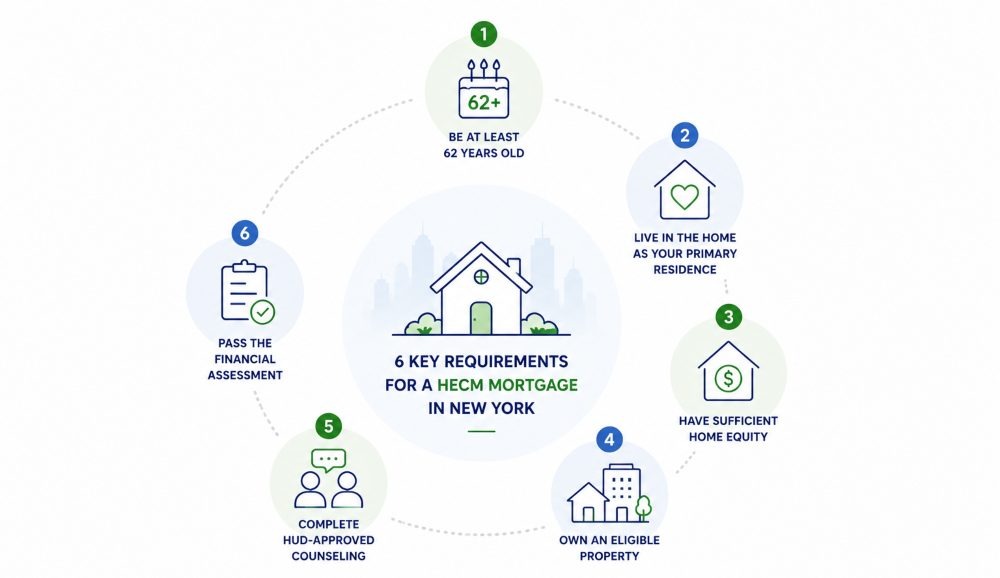
1. Be at Least 62 Years Old
The first requirement is age. To qualify for a HECM mortgage in New York, the youngest borrower listed on the loan must generally be at least 62 years old.
Age also plays an important role in determining how much you may be eligible to borrow. In general, older borrowers qualify for higher principal limits because the expected loan term is shorter.
2. Live in the Home as Your Primary Residence
HECM mortgages are designed for homeowners who plan to remain in their homes.
To qualify, the property must be your primary residence, meaning you live there for the majority of the year. Vacation homes, second homes, and most investment properties aren’t eligible.
If you permanently move out of the home; for example, to relocate or move into long-term care; the loan will generally become due.
3. Have Sufficient Home Equity
Because a HECM is based on your existing home equity, you’ll need to have built up a substantial ownership interest in your property.
While there isn’t a fixed percentage required, homeowners with more equity generally qualify for larger loan amounts. If you still have an existing mortgage, you may still qualify, provided enough equity remains to pay off the balance at closing.
4. Own an Eligible Property
Not every home qualifies for a HECM mortgage. Eligible property types generally include:
- Single-family homes
- FHA-approved condominiums
- Two- to four-unit properties where you occupy one unit as your primary residence
- Certain manufactured homes that meet FHA requirements
Your property must also meet FHA minimum standards for safety, security, and habitability, which will be verified during the appraisal process.
5. Complete HUD-Approved Counseling
Before your HECM application can move forward, you’ll need to complete a counseling session with an independent HUD-approved HECM counselor.
This session is designed to help you understand:
- How a HECM mortgage works
- The costs involved
- Your ongoing responsibilities
- Alternative financial solutions
- The long-term impact on your home equity
After completing the session, you’ll receive a counseling certificate that must be provided to your lender before the loan process can continue.
6. Pass the Financial Assessment
Although HECM mortgages don’t require traditional income qualification, lenders must still complete a financial assessment. This review helps determine whether you’re likely to continue meeting your homeowner obligations after closing, including:
- Paying property taxes
- Maintaining homeowners insurance
- Keeping the home in good condition
The lender may also review your credit history, income sources, monthly obligations, and available assets as part of this assessment.
Meeting these requirements is the first step toward obtaining a HECM mortgage in New York. Once your eligibility has been confirmed, your lender can determine how much you may qualify to borrow, a calculation influenced by several factors beyond your home’s value alone, which we’ll explore in the next section.
HECM Mortgage Loan Limits: How Much Can You Borrow?
One of the most common questions homeowners ask when considering a HECM mortgage in New York is, “How much money can I receive?”
The answer depends on several factors, and it’s often different than people expect. Unlike a traditional mortgage, where your borrowing power is based primarily on your income, a HECM mortgage is largely determined by your available home equity and several FHA-established guidelines.
Your lender calculates your available loan proceeds, known as your principal limit, using a combination of your age, your home’s appraised value, current interest rates, the outstanding balance of any existing mortgage, and the FHA’s annual maximum claim amount.
Because every homeowner’s situation is different, two borrowers with homes of the same value may qualify for different loan amounts.
What Determines Your Borrowing Amount?
The following factors have the greatest impact on how much you may be eligible to receive through a HECM mortgage in New York.
| Factor | How It Affects Your Loan Amount |
| Your Age | Older borrowers generally qualify for larger loan proceeds because the expected loan term is shorter. |
| Home Value | Homes with higher appraised values may qualify for larger principal limits, subject to FHA lending limits. |
| Current Interest Rates | Lower interest rates generally increase the amount available to borrow, while higher rates may reduce it. |
| Existing Mortgage Balance | Any outstanding mortgage must usually be paid off at closing, reducing the amount of equity available to you. |
| FHA Maximum Claim Amount | The FHA sets an annual maximum claim amount that limits how much of your home’s value can be used when calculating the loan. |
Why Age Makes Such a Difference
One of the unique features of a HECM mortgage is that your age directly affects your borrowing power.
In general, the older you are, the more equity you may be able to access. This is because the FHA’s calculation assumes that older borrowers are likely to have a shorter loan term than younger borrowers, allowing a larger percentage of the home’s equity to be made available.
For example, a 78-year-old homeowner may qualify for a higher principal limit than a 63-year-old homeowner with the same home value and similar financial profile.
Your Home’s Value Isn’t the Only Number That Matters
Many homeowners assume they’ll be able to borrow a fixed percentage of their home’s value, but that’s not how HECM mortgages in New York work.
Even if two homes have identical appraised values, the available loan proceeds can differ based on the borrower’s age, current interest rates, and any existing mortgage that must be paid off. Additionally, the FHA’s maximum claim amount places a cap on the value used to calculate loan proceeds, even if your home is worth substantially more.
Because so many variables are involved, the best way to determine how much you may qualify to receive is to speak with an experienced mortgage banker who can prepare a personalized estimate based on your individual circumstances.
Understanding how your borrowing amount is calculated is only part of the decision. Equally important is deciding how you want to receive your funds, whether as a lump sum, monthly payments, a line of credit, or a combination of payment options.
We’ll explore each of these options for HECM mortgage in New York in the next section.
What HECM Payment Options Do I Have?
One of the biggest advantages of choosing a HECM mortgage in New York is the flexibility it offers. Unlike many traditional loans, a Home Equity Conversion Mortgage allows you to choose how you receive your funds based on your financial needs and retirement goals.
Whether you’re looking to eliminate an existing mortgage payment, create a reliable monthly income, prepare for unexpected expenses, or simply have access to additional cash when needed, there’s a payment option designed to fit your situation.
Your mortgage banker will help you evaluate each option before closing, but understanding how they work can help you make a more informed decision.
1. Lump Sum
With the lump sum option, you receive a single payment at closing. Many homeowners choose this option to:
- Pay off an existing mortgage.
- Cover a major medical expense.
- Complete a significant home renovation.
- Consolidate higher-interest debt.
This option can provide immediate access to a large amount of equity, making it ideal for homeowners with substantial one-time financial needs.
2. Line of Credit
A HECM line of credit allows you to access funds only when you need them, rather than receiving all of your available equity upfront.
Many retirees choose this option because it provides ongoing financial flexibility for unexpected expenses, healthcare costs, or future home repairs.
Unlike a traditional home equity line of credit (HELOC), you’re generally not required to make monthly repayments on the amount you’ve accessed, provided you continue to meet the terms of the loan.
3. Monthly Tenure Payments
If your goal is to create a predictable stream of retirement income, tenure payments may be an attractive option.
With this payment plan, you’ll receive equal monthly payments for as long as at least one borrower continues to live in the home as their primary residence and complies with the loan requirements.
This option is often chosen by homeowners looking to supplement Social Security, pension benefits, or retirement savings.
4. Monthly Term Payments
Term payments also provide fixed monthly payments, but only for a specific period that you choose when the loan is established.
For example, you might elect to receive payments for 5, 10, or 15 years, depending on your financial goals.
This option may be appropriate if you anticipate larger expenses during a particular stage of retirement but don’t require lifetime monthly payments.
5. Combination Payment Plans
Many homeowners discover that the best solution isn’t just one payment option.
HECM mortgages also allow certain combinations, such as receiving a smaller line of credit alongside monthly payments. This flexibility makes it possible to create a personalized retirement strategy that adapts to both your current needs and future financial goals.
6. Which Payment Option Is Right for You?
There isn’t a single “best” choice. The right payment option depends on how you plan to use your home equity, your retirement income, and your long-term financial objectives.
For example:
- If your priority is paying off an existing mortgage, a lump sum may make the most sense.
- If you’re looking for ongoing supplemental income, monthly tenure payments may be a better fit.
- If you want maximum flexibility for future expenses, a line of credit could be the most appropriate solution.
- If you have both immediate and long-term financial needs, a combination payment plan may provide the greatest balance.
Choosing the right payment option is one of the most important decisions you’ll make when obtaining a HECM mortgage in New York. An experienced mortgage banker can help you compare each option and determine which one best supports your retirement strategy and long-term financial goals.
Is a HECM Mortgage in New York Right for You?
A HECM mortgage in New York can be a valuable financial tool for homeowners who want to access the equity they’ve built over decades while continuing to live in the home they love.
Whether your goal is to supplement your retirement income, eliminate an existing mortgage payment, cover unexpected expenses, or simply create greater financial flexibility, a Home Equity Conversion Mortgage may offer a solution that aligns with your long-term needs.
As you’ve learned throughout this guide, a HECM is more than just a reverse mortgage; it’s a federally insured loan with built-in consumer protections, flexible payment options, and qualification requirements designed to help eligible homeowners make informed financial decisions.
Understanding how the program works, who qualifies, how much you may be able to borrow, and the responsibilities that come with the loan can help you determine whether it’s the right fit for your retirement strategy.
At Jet Direct Mortgage, we’re committed to providing clear, unbiased guidance so you can explore your options with confidence. If you’re considering a HECM mortgage in New York, our experienced team is here to answer your questions, explain the available loan options, and help you determine the best path forward based on your unique financial goals.
Frequently Asked Questions
What is a HECM mortgage?
A HECM (Home Equity Conversion Mortgage) is a federally insured reverse mortgage backed by the Federal Housing Administration (FHA). It allows eligible homeowners aged 62 and older to convert a portion of their home equity into available funds while continuing to live in their home.
Is a HECM mortgage the same as a reverse mortgage?
A HECM is a type of reverse mortgage, but not all reverse mortgages are HECMs. HECMs are insured by the FHA and follow federal guidelines, while proprietary reverse mortgages are offered by private lenders and may have different eligibility requirements and loan limits.
Who qualifies for a HECM mortgage in New York?
To qualify for a HECM mortgage in New York, you generally must be at least 62 years old, live in the home as your primary residence, have sufficient home equity, complete HUD-approved counseling, and meet the lender’s financial assessment requirements.
How much can I borrow with a HECM mortgage?
The amount you can borrow depends on several factors, including your age, your home’s appraised value, current interest rates, your existing mortgage balance, and the FHA’s annual maximum claim amount.
Do I still own my home with a HECM mortgage?
Yes. You remain the legal owner of your home as long as you continue to meet the loan obligations, including living in the property as your primary residence, paying property taxes and homeowners insurance, and maintaining the home.
Do I have to make monthly mortgage payments?
One of the primary benefits of a HECM mortgage is that monthly mortgage payments are generally not required. However, you’re still responsible for paying property taxes, homeowners insurance, and maintaining the property.
What payment options are available?
Depending on your financial goals, you may choose to receive your HECM proceeds as a lump sum, monthly tenure payments, monthly term payments, a line of credit, or a combination of these options.
What happens when the loan becomes due?
A HECM mortgage typically becomes due when the last eligible borrower permanently moves out of the home, sells the property, or passes away. At that point, the loan is generally repaid from the sale of the home, although heirs may have options to retain the property if they satisfy the loan according to FHA guidelines.
Is HUD counseling required for a HECM mortgage?
Yes. Before obtaining a federally insured HECM mortgage, borrowers must complete a counseling session with an independent HUD-approved counselor. This requirement helps ensure you fully understand the loan, its costs, your responsibilities, and the available alternatives.
Why choose Jet Direct Mortgage for a HECM mortgage in New York?
At Jet Direct Mortgage, we take the time to explain every aspect of the HECM program so you can make an informed decision with confidence.
From your initial consultation through closing, our experienced mortgage professionals provide personalized guidance, answer your questions, and help you determine whether a HECM mortgage in New York is the right solution for your retirement and financial goals.