Compare HECMs and proprietary reverse mortgages side by side. Learn the differences in borrowing limits, eligibility, costs, benefits, and which option may be right for your home.
If you’re exploring a reverse mortgage in New York, one of the biggest decisions you’ll make is choosing between a HECM and a proprietary reverse mortgage.
While both loans allow you to convert a portion of your home’s equity into tax-free loan proceeds without selling your home or making monthly mortgage payments, they’re designed for different types of homeowners and properties.
A Home Equity Conversion Mortgage (HECM) is the only reverse mortgage insured by the Federal Housing Administration (FHA) and is the most common option in the United States.
A proprietary reverse mortgage, often called a jumbo reverse mortgage, is offered by private lenders and is typically designed for homeowners with higher-value properties that exceed FHA lending limits.

According to the Consumer Financial Protection Bureau (CFPB), these are the two primary reverse mortgage options available for homeowners seeking to access their home equity.
So, which reverse mortgage is right for you? The answer depends on your home’s value, the amount of equity you’ve built, how much you want to borrow, and the features that matter most to your financial goals.
In this guide, we’ll compare HECM vs. proprietary reverse mortgage options side by side, including eligibility requirements, borrowing limits, costs, consumer protections, and the types of homeowners each loan is designed for.
By the end, you’ll have a clear understanding of which reverse mortgage is the better fit for your situation.
HECM vs. Proprietary Reverse Mortgage: The Quick Answer
Both loans let you convert part of your home equity into cash while continuing to live in your home, but they’re designed for different financial situations. The right choice isn’t about which loan is “better”р it’s about which one aligns with your home’s value, your retirement goals, and how much equity you want to access.
As a general rule:
- A HECM is often the better choice if your home falls within FHA lending limits and you value the security of a federally insured loan with standardized consumer protections.
- A proprietary reverse mortgage, sometimes called a jumbo reverse mortgage, is typically worth considering if your home’s value significantly exceeds FHA lending limits and you want to maximize the equity available from your property.
When comparing the two, there are six questions that matter most:
- How much can you borrow?
- What are the eligibility requirements?
- How much will the loan cost?
- Which property types qualify?
- What consumer protections are included?
- Which loan best fits your financial goals?
The rest of this guide walks through each of these factors so you can confidently compare a HECM vs. proprietary reverse mortgage and determine which option is the better fit for your situation.
Here is quick comparison:
| HECM | Proprietary Reverse Mortgage |
| FHA-insured | Privately funded |
| Standardized FHA rules | Terms vary by lender |
| Subject to FHA lending limits | No FHA lending limit |
| Best for most homeowners | Best for higher-value homes |
| Includes FHA mortgage insurance | Typically no FHA mortgage insurance |
Which Loan Lets You Borrow More?
For many homeowners, the most important question when comparing a HECM vs. proprietary reverse mortgage is simple: Which loan gives me access to more of my home equity?
The answer depends largely on your home’s value.
A HECM calculates your available loan amount using the lower of your home’s appraised value or the FHA maximum claim amount. This means that once your home’s value exceeds the FHA lending limit, the additional value generally isn’t considered when calculating your available proceeds.
As a result, homeowners with luxury or high-value properties may not be able to access as much equity as they expected through a HECM.
A proprietary reverse mortgage, often referred to as a jumbo reverse mortgage, isn’t restricted by FHA lending limits. Instead, private lenders establish their own maximum loan amounts and underwriting guidelines, which may allow qualifying homeowners to borrow substantially more against higher-value properties.
Example
Imagine two homeowners who are both:
- 75 years old
- Have paid off their mortgage
- Live in New York
- Apply with similar interest rates
The only difference is their home’s value.
| Home Value | HECM | Proprietary Reverse Mortgage |
| $800,000 | May provide similar borrowing potential | May provide similar borrowing potential |
| $1.5 million | Limited by FHA lending limits | May allow access to additional equity |
| $3 million | Limited by FHA lending limits | May provide significantly higher borrowing potential |
While this example is simplified, it illustrates why many owners of luxury homes begin exploring jumbo reverse mortgages once their property value significantly exceeds FHA lending limits.
Home Value Isn’t the Only Factor
Even with a proprietary reverse mortgage in New York, lenders don’t simply lend a percentage of your home’s value. They also evaluate several factors, including:
- Your age (or the age of the youngest borrower)
- Your available home equity
- Current interest rates
- Your property’s appraised value
- The lender’s underwriting guidelines
That’s why two homeowners with similarly valued properties may still qualify for different loan amounts.
Key Takeaway
If your home falls within FHA lending limits, a HECM may provide borrowing power that’s very similar to a proprietary reverse mortgage. However, if you own a high-value property, a proprietary (jumbo) reverse mortgage may allow you to unlock substantially more equity simply because it isn’t constrained by FHA lending limits.
Comparing Costs Between HECM vs. Proprietary Reverse Mortgage: Which One Is More Expensive?
When comparing a HECM vs. proprietary reverse mortgage, it’s natural to focus on interest rates or closing costs. However, those numbers only tell part of the story. The real cost of a reverse mortgage depends on how the loan is structured, the protections it provides, and how much equity it allows you to access.
One of the biggest differences is mortgage insurance. Every FHA-insured HECM includes an upfront and annual Mortgage Insurance Premium (MIP).
According to the U.S. Department of Housing and Urban Development (HUD), this insurance protects both borrowers and lenders by guaranteeing loan obligations and providing the non-recourse feature, which ensures you or your heirs will never owe more than the home’s value when the loan becomes due.
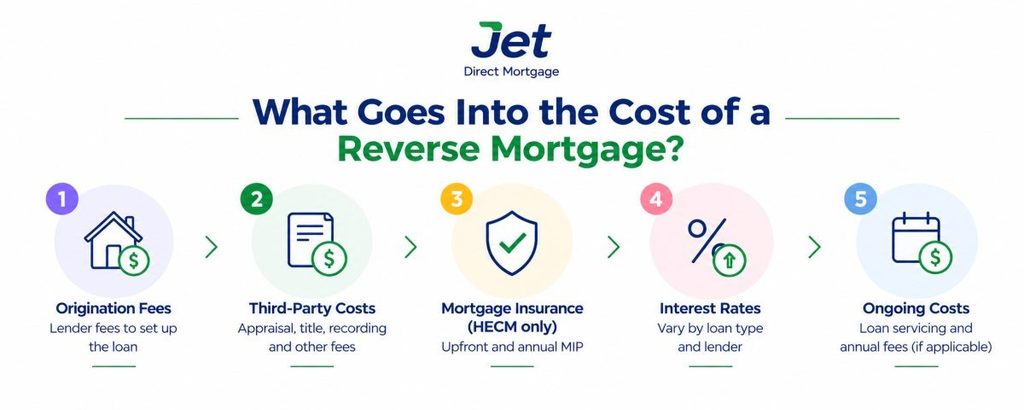
A proprietary reverse mortgage doesn’t include FHA mortgage insurance because it’s funded by a private lender. Instead, each lender determines its own pricing, interest rates, fees, and underwriting guidelines.
That means two proprietary reverse mortgage offers can look very different, making it especially important to compare lenders rather than assuming every program is the same.
Think About Value, Not Just Cost
Rather than asking “Which loan is cheaper?”, consider what you’re receiving in return.
A HECM may cost more because of FHA mortgage insurance, but it also includes standardized consumer protections and government backing. A proprietary reverse mortgage may eliminate those insurance premiums while giving owners of higher-value homes access to substantially more equity.
For many homeowners, the better question is:
Would you rather pay less for the loan, or gain access to significantly more of your home’s equity?
The answer depends entirely on your financial goals. If your property falls within FHA lending limits, a HECM may provide excellent value. If your home is worth considerably more, a proprietary reverse mortgage in New York may justify its cost by making far more equity available than a traditional HECM.
Which Reverse Mortgage Is Right for You? (HECM vs. Proprietary Reverse Mortgage)
After comparing borrowing potential, costs, and loan features, the next question becomes much more personal:
Which reverse mortgage best fits your situation?
The answer depends less on the loan itself and more on your home, your financial goals, and how you plan to use your home equity.
A HECM May Be the Better Choice If…
A Home Equity Conversion Mortgage (HECM) is often an excellent fit if you own a home that falls within FHA lending limits and you’re looking for a government-insured reverse mortgage with standardized rules and consumer protections.
A HECM may be right for you if you:
- Your home’s value falls comfortably within FHA lending limits.
- You want the security of a federally insured loan.
- You prefer standardized fees and lending guidelines.
- You’re looking for one of the most widely available reverse mortgage products.
For many homeowners, a HECM provides all the borrowing power they need while offering the added confidence of FHA oversight.
A Proprietary Reverse Mortgage May Be the Better Choice If…
A proprietary reverse mortgage, often referred to as a jumbo reverse mortgage, is designed for homeowners who may benefit from greater borrowing flexibility.
It may be the better option if you:
- Own a high-value home that exceeds FHA lending limits.
- Want to maximize the amount of equity you can access.
- Own a luxury property, waterfront home, Manhattan condominium, Brooklyn brownstone, or another high-value residence.
- Own a qualifying New York co-op that isn’t eligible for a traditional HECM.
- Want to compare privately funded reverse mortgage programs tailored to higher-value homes.
For these homeowners, a proprietary reverse mortgage may unlock substantially more equity than a HECM, making it easier to supplement retirement income, cover healthcare expenses, renovate a home, or simply create greater financial flexibility.
The Best Choice Isn’t Always the One That Lets You Borrow the Most
While borrowing potential is important, it shouldn’t be the only factor driving your decision.
A HECM may offer stronger standardized protections through its FHA insurance, while a proprietary reverse mortgage may provide greater access to your home’s equity. The right choice is the one that balances loan proceeds, costs, protections, and long-term financial goals.
Key Takeaway
Choosing between a HECM vs. proprietary reverse mortgage isn’t about finding the “better” loan, it’s about finding the loan that’s better for you. Comparing both options side by side allows you to make an informed decision based on your home’s value, your retirement objectives, and the features that matter most.
Can You Switch from a HECM to a Proprietary Reverse Mortgage?
Yes; in some cases, you can refinance a HECM into a proprietary reverse mortgage. This is most commonly considered by homeowners whose properties have appreciated significantly in value since they first obtained their reverse mortgage.
For example, imagine you took out a HECM several years ago when your home was worth $900,000. If your property is now worth $1.8 million, a proprietary reverse mortgage may allow you to access additional home equity because it isn’t limited by FHA lending caps.
Refinancing may also make sense if:
- Your home’s value has increased substantially.
- You need additional funds for retirement, healthcare, or other expenses.
- A proprietary reverse mortgage offers greater borrowing potential than your current HECM.
- You’re looking for a loan program better suited to a high-value property.
However, refinancing isn’t automatically the right decision. Like any new mortgage, it may involve closing costs, updated underwriting, a new appraisal, and different loan terms.
Before refinancing, it’s important to compare the additional proceeds you’ll receive against the costs of replacing your existing loan.
When Does Refinancing Usually Make Sense?
In general, refinancing from a HECM to a proprietary reverse mortgage is most beneficial when the increase in available loan proceeds significantly outweighs the cost of obtaining the new loan.
If your home has appreciated dramatically or now exceeds FHA lending limits by a wide margin, refinancing could unlock substantially more equity than your original HECM allowed.
HECM vs. Proprietary Reverse Mortgage: Which One Should You Choose?
Choosing between a HECM vs. proprietary reverse mortgage comes down to one simple question: Which loan best fits your home and your financial goals?
If your home falls within FHA lending limits, a HECM may provide everything you need while offering the security of a federally insured program with standardized consumer protections. If you own a high-value property, a proprietary reverse mortgage, often called a jumbo reverse mortgage, may allow you to access substantially more of your home’s equity without being restricted by FHA lending limits.
There’s no one-size-fits-all answer. The right loan depends on your home’s value, your available equity, how much you want to borrow, and the features that matter most to your retirement plans.
At Jet Direct Mortgage, we help homeowners compare both options side by side, so you can understand your borrowing potential, loan costs, and available payment options before making a decision.
Ready to compare your options? Contact Jet Direct Mortgage today for a personalized reverse mortgage consultation and find out whether a HECM or a proprietary reverse mortgage is the better fit for your home.
Frequently Asked Questions
What’s the difference between a HECM and a proprietary reverse mortgage?
A HECM is the only reverse mortgage insured by the Federal Housing Administration (FHA). A proprietary reverse mortgage is offered by a private lender and isn’t subject to FHA lending limits. While both allow you to convert home equity into cash, proprietary reverse mortgages are generally designed for homeowners with higher-value properties.
Which reverse mortgage lets you borrow more?
If your home exceeds FHA lending limits, a proprietary reverse mortgage may allow you to borrow significantly more than a HECM. For homes within FHA lending limits, borrowing amounts are often similar and depend on your age, available equity, interest rates, and the specific loan program.
Is a proprietary reverse mortgage the same as a jumbo reverse mortgage?
In most cases, yes. The terms proprietary reverse mortgage and jumbo reverse mortgage are commonly used interchangeably. Both refer to privately funded reverse mortgages designed for homeowners with higher-value properties.
Which reverse mortgage is better for luxury homes?
A proprietary reverse mortgage is often the better choice for luxury homes because it isn’t limited by FHA lending caps. This may allow homeowners with high-value properties to access substantially more equity than a traditional HECM.
Are proprietary reverse mortgages insured by the FHA?
No. Proprietary reverse mortgages are funded by private lenders and aren’t insured by the FHA. As a result, loan terms, borrowing limits, and eligibility requirements vary by lender.
Do HECMs have more consumer protections?
Yes. Because HECMs are federally insured, they follow standardized FHA guidelines and include important borrower protections, such as mandatory HUD counseling and the non-recourse feature, which ensures you or your heirs won’t owe more than the home’s value when the loan becomes due.
Which reverse mortgage has lower costs?
Neither loan is always less expensive. A HECM includes FHA mortgage insurance premiums, while proprietary reverse mortgages generally don’t. However, proprietary lenders establish their own interest rates and fees, so the total cost depends on the specific loan you’re comparing.
Can I refinance a HECM into a proprietary reverse mortgage?
Yes. If your home’s value has increased significantly or now exceeds FHA lending limits, refinancing into a proprietary reverse mortgage may allow you to access additional equity. Before refinancing, compare the potential increase in loan proceeds with the costs of obtaining a new loan.
Can I switch from a proprietary reverse mortgage to a HECM?
Possibly. Whether you qualify depends on your home’s current value, available equity, your age, and FHA eligibility requirements. A reverse mortgage specialist can help you compare both options and determine which program best fits your current financial situation.
How do I know which reverse mortgage is right for me?
The best way to compare a HECM vs. proprietary reverse mortgage is to evaluate your home’s value, available equity, borrowing goals, expected loan proceeds, costs, and payment options. For many homeowners, reviewing personalized estimates for both loan types provides the clearest picture of which option offers the greatest overall value.

Experienced Chief Operating Officer with a 26 + year demonstrated history of working in the banking industry. Skilled in all aspects of the residential mortgage market . Strong business development professional with a Bachelor of Science (BS) focused in Business Administration and Management, from St. Joseph College. A direct endorsement underwriter and a licensed Mortgage Loan Originator.