If you’re considering refinancing your home on Long Island this year, finding a competitive interest rate could help you lower your monthly mortgage payments, reduce the total interest you pay, or access some of the equity you’ve built in your property.
However, the best refinance rate isn’t necessarily the lowest advertised rate. Closing costs, loan terms, and your financial profile all play an important role in determining how much you’ll actually save.
Whether you own a home in Nassau or Suffolk County, comparing Long Island home refinance rates can help you understand your options and make a more informed financial decision.
In this guide, we’ll explore current refinance rates on Long Island, explain what affects the rates lenders offer, and show you how to compare refinancing options. You can also use our mortgage refinance calculator to estimate your new monthly payment, potential savings, and how long it could take to recover your refinancing costs.
If you want a complete guide on home refinancing in Long Island, make sure to also check our article Long Island Mortgage Refinancing.
What Are the Current Mortgage Refinance Rates on Long Island?
Current home refinance rates on Long Island vary depending on the type of mortgage, loan term, your credit score, available home equity, and the lender you choose.
Generally, 15-year fixed-rate mortgages have lower interest rates than 30-year loans, while FHA, VA, conventional, and cash-out refinancing programs have different pricing and eligibility requirements.
When comparing current Long Island home refinance rates, it’s important to look at both the advertised interest rate and the annual percentage rate (APR). The interest rate determines how much interest accrues on your loan, while the APR incorporates certain additional borrowing costs, helping you compare offers more accurately.
Current Long Island Refinance Rates by Loan Type
The table below provides a snapshot of recent national mortgage refinance rate averages to help you understand the differences between loan programs. These figures are useful benchmarks when comparing Long Island mortgage refinance rates, but they aren’t personalized quotes from Jet Direct Mortgage or averages specific to Nassau and Suffolk County.
Rates as of October 16, 2026
Mortgage Refinance Rates by Loan Type
National benchmarks | October 16, 2026
| Refinance Loan Type | Interest Rate | APR |
|---|---|---|
| 30-Year Fixed Conventional | 7.58% | 7.65% |
| 15-Year Fixed Conventional | 6.93% | 7.06% |
| 30-Year FHA Refinance | 7.64% | 7.85% |
| 30-Year VA Refinance | 7.68% | 7.91% |
| Cash-Out Refinance | Varies by borrower | Varies |
A 30-year refinance typically offers lower monthly principal-and-interest payments than a 15-year loan of the same amount, while a shorter term can reduce the total interest you pay. FHA and VA refinancing programs have different eligibility requirements and fee structures, so comparing interest rates alone may not reveal the full cost of borrowing.
For a cash-out refinance, your rate also depends on how much equity you want to withdraw and how the new loan affects your loan-to-value ratio.
Are Long Island Refinance Rates Higher or Lower Than National Averages?
Mortgage refinance rates on Long Island aren’t automatically higher or lower than national averages. Lenders generally price loans based on broader financial markets and individual borrower characteristics, rather than simply whether your home is located in Nassau or Suffolk County.
For context, Freddie Mac’s Primary Mortgage Market Survey reported a national average of 7.40% for 30-year fixed mortgages and 6.71% for 15-year fixed mortgages on October 15, 2026. However, these figures reflect conventional home-purchase loans for borrowers with excellent credit and 20% down, not refinance-specific offers.
This distinction matters because national purchase-rate benchmarks and refinance-rate averages measure different loan categories. Neither tells you exactly what rate you’ll qualify for.
For example, if you own a $900,000 home in Nassau County with substantial equity and excellent credit, you may qualify for a different rate than a homeowner in Suffolk County with a similar property value but a higher loan-to-value ratio or a lower credit score.
The most reliable way to determine whether you’re getting a competitive offer is to compare personalized refinance quotes for the same loan amount, term, and rate-lock period, paying attention to both APR and closing costs.
Long Island Refinance Calculator: How Much Could You Save?
Finding a lower mortgage refinance rate is only the first step. What really matters is how that new rate affects your monthly payments, total borrowing costs, and long-term savings. A refinance that lowers your interest rate could save you hundreds of dollars per month, but closing costs and changes to your loan term can affect whether it’s worthwhile.
Use our Long Island mortgage refinance calculator to estimate your potential savings before applying. Enter your remaining mortgage balance, current interest rate, remaining loan term, and the new rate you’re considering.
Long Island Mortgage Refinance Calculator
Compare your existing mortgage with a new loan, estimate costs and find your potential break-even point.
1. Your current mortgage
2. Your new refinance loan
3. Refinance closing costs
4. Property costs and your plans
Your refinance results
Compare your loan options
| Mortgage comparison | Current | Refinanced |
|---|---|---|
| Principal balance at start | — | — |
| Interest rate | — | — |
| Monthly principal & interest | — | — |
| Monthly housing cost incl. entered expenses | — | — |
| Interest until payoff | — | — |
| Balance after your selected horizon | — | — |
Projected remaining loan balance
This is an educational estimate, not a loan offer, APR quote, eligibility decision, or guarantee of savings. Rates are user-entered hypothetical values, not live rates. Monthly housing totals include only the taxes, insurance, HOA, and mortgage insurance amounts you enter; they do not include all possible ownership expenses. Loan-type-specific mortgage insurance, funding fees, and underwriting rules are not automatically applied. Closing costs and financed fees are estimated; prepaids and escrow funding are excluded from the economic break-even calculation. The simple break-even figure compares monthly P&I payments and does not account for differences in principal reduction, tax consequences, opportunity costs, or future changes in rates or insurance. The horizon cash-flow figure compares payments and upfront cash but does not include remaining equity differences; compare the projected balances alongside it. For accurate loan costs, request a personalized Loan Estimate from Jet Direct Mortgage.
You can also adjust the new loan term and estimated closing costs to see how different refinancing scenarios compare.
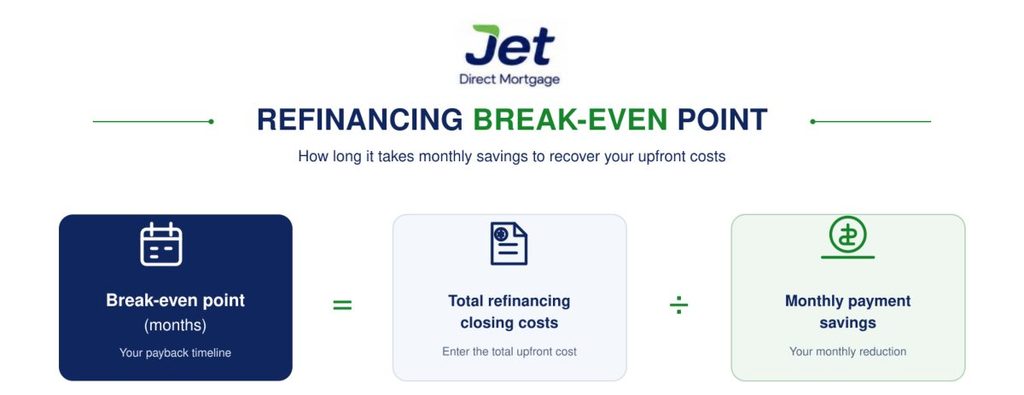
Consider a Long Island homeowner with the following mortgage scenario:
Mortgage Refinance Savings Example
See how a 1% lower interest rate could affect your monthly mortgage payment.
| Mortgage Details | Current Loan | New Refinance Loan |
|---|---|---|
| Remaining Loan Balance | $400,000 | $400,000 |
| Interest Rate | 7.00% | 6.00% |
| Remaining / New Loan Term | 30 years | 30 years |
| Monthly Principal & Interest | $2,661 | $2,398 |
| Monthly Savings | — | $263 |
If refinancing costs $6,000, the homeowner’s estimated break-even point would be:
$6,000 ÷ $263 = approximately 23 months
In this example, you would need to keep the refinanced mortgage for roughly two years to recover your upfront costs through monthly payment savings. If you plan to sell your home or refinance again before then, the savings might not justify the expense.
This simplified calculation works best when you’re comparing loans with similar remaining repayment periods. It doesn’t capture every financial consequence of refinancing, such as changes to your loan balance, tax treatment, or total interest over time.
Does a Lower Monthly Payment Always Mean You’re Saving Money?
Not necessarily. One of the most common refinancing mistakes is focusing exclusively on the new monthly payment without considering how long you’ll be making those payments.
Imagine you have 20 years remaining on your mortgage, but you refinance into a new 30-year loan. Even if the new interest rate is lower, extending your repayment period by another decade could increase the total interest you pay over the life of the mortgage.
On the other hand, refinancing into a shorter term could help you become mortgage-free sooner and save substantially on interest, even if your monthly payment increases.
That’s why it’s worth comparing three numbers before making a decision: your new monthly payment, your refinancing costs, and the total remaining interest under each loan.
The best refinancing option isn’t always the one with the lowest monthly payment. It’s the one that helps you achieve your financial goals at a cost that makes sense for how long you expect to keep your Long Island home.
What Factors Affect Your Home Refinance Rate on Long Island?
When comparing current Long Island home refinance rates, you may notice that two lenders advertise different interest rates for the same type of mortgage. Even when the advertised rates are identical, the actual offers you receive can vary based on your financial profile, the property you’re refinancing, and the terms of your new loan.
Understanding these factors can help you qualify for more competitive Long Island mortgage refinance rates and identify opportunities to reduce your borrowing costs before submitting an application.
Credit Score and Financial Profile
Your credit score is one of the most important factors lenders consider when determining your mortgage refinance rate. Generally, borrowers with stronger credit histories qualify for more competitive rates because lenders view them as lower-risk applicants.
However, your credit score isn’t the only consideration. Lenders also evaluate your income, employment stability, existing debts, and debt-to-income (DTI) ratio.
For example, two homeowners with a credit score of 740 may receive different refinance offers if one has significantly higher monthly debt obligations.
What can you do to improve your refinancing prospects? Before applying, review your credit reports for errors, avoid opening unnecessary new credit accounts, and consider paying down high-interest revolving debt. These steps may strengthen your financial profile, although they don’t guarantee a lower rate.
Home Equity and Loan-to-Value Ratio
The amount of equity you’ve built in your home can also influence the refinance rates available to you.
Lenders measure this using your loan-to-value (LTV) ratio, which compares your mortgage balance with your home’s appraised value.
For example, imagine you own a home in Nassau County worth $800,000 and have a remaining mortgage balance of $480,000.
Your LTV would be:
That means you have approximately $320,000 in home equity, or 40% of the property’s value.
A lower LTV can improve your refinancing options because you’re borrowing a smaller percentage of your property’s value. Depending on the loan program, it may also help you qualify for more favorable pricing or avoid certain mortgage insurance requirements.
However, having less than 20% equity doesn’t automatically disqualify you from refinancing. Some conventional and government-backed refinance programs allow higher LTV ratios, subject to their eligibility requirements.
Loan Type, Term, and Mortgage Points
Your choice of mortgage product directly affects the interest rate and overall cost of refinancing.
- Loan term: A 15-year fixed-rate refinance generally offers a lower interest rate than a comparable 30-year loan, but your monthly principal-and-interest payment will usually be higher because you’re repaying the balance faster.
- Loan program: Conventional, FHA, VA, and jumbo refinance loans have different eligibility requirements, pricing structures, and fees. The lowest advertised interest rate isn’t necessarily the least expensive option once mortgage insurance, funding fees, and closing costs are considered.
- Discount points: Some lenders allow you to pay an upfront fee to secure a lower interest rate. One discount point typically costs 1% of your loan amount, although the rate reduction you receive varies by lender and market conditions.
For example, paying one point on a $400,000 refinance would cost $4,000 upfront. Whether that expense is worthwhile depends on how much it lowers your monthly payment and how long you expect to keep the mortgage.
Why Two Long Island Homeowners May Receive Different Refinance Rates
Consider two homeowners refinancing similarly valued properties in Suffolk County.
Both homes are worth $750,000, and both homeowners want a new 30-year fixed-rate mortgage. However, their financial circumstances are different.
How Borrower Profiles Affect Refinance Rates
Two Long Island homeowners with similarly valued properties may qualify for different mortgage rates.
| Borrower Details | Homeowner A | Homeowner B |
|---|---|---|
| Home Value | $750,000 | $750,000 |
| Mortgage Balance | $450,000 | $600,000 |
| Loan-to-Value Ratio | 60% | 80% |
| Credit Score | 780 | 680 |
| Refinance Type | Rate-and-term | Rate-and-term |
Although both homeowners live in the same county and want the same loan term, Homeowner A may qualify for more favorable pricing because of their stronger credit profile and lower LTV ratio.
Homeowner B may still qualify for refinancing, but their available interest rates, fees, and mortgage insurance requirements could differ.
The takeaway: Finding the best refinance rates on Long Island isn’t simply about choosing the lender advertising the lowest number. Your creditworthiness, home equity, loan structure, and upfront costs all influence the offer you receive.
That’s why comparing personalized Loan Estimates from multiple lenders is one of the most effective ways to determine whether you’re getting a competitive refinancing deal.
How to Find the Best Refinance Rates on Long Island
Finding the best refinance rates on Long Island requires more than comparing the interest rates advertised on mortgage lenders’ websites. A lender offering a slightly lower rate may charge higher upfront fees, while another may offer a more competitive overall deal with fewer closing costs.
To find the right refinancing offer, you need to compare what each lender is actually charging for the same loan amount, repayment term, and rate-lock period.
Compare Interest Rates and APR, Not Just Advertised Rates
When researching Long Island home refinance rates, you’ll encounter two important numbers: the mortgage interest rate and the annual percentage rate (APR).
Your interest rate determines how much interest you pay on the outstanding mortgage balance. The APR provides a broader measure of borrowing costs by incorporating the interest rate and certain additional charges, such as discount points and lender fees.
For example, consider two hypothetical refinance offers for the same $400,000 mortgage:
Comparing Two Mortgage Refinance Offers
A lower interest rate doesn’t always mean lower overall borrowing costs.
| Loan Details | Lender A | Lender B |
|---|---|---|
| Interest Rate | 5.75% | 5.875% |
| APR | 6.10% | 5.98% |
| Upfront Lender Costs | Higher | Lower |
| Monthly Principal & Interest | $2,334 | $2,366 |
Illustrative 30-year fixed-rate mortgage offers. Monthly payments are rounded and exclude taxes, insurance, and closing costs. APRs are hypothetical and do not represent actual lender quotes.
Lender A offers a lower interest rate and saves you approximately $32 per month compared with Lender B. However, its higher APR suggests that additional borrowing costs may offset some of those savings.
Does that automatically make Lender B the better choice? Not necessarily. If you plan to keep your mortgage for many years, the lower monthly payment from Lender A could eventually outweigh its higher upfront costs.
The important distinction is that a lower interest rate doesn’t always mean a less expensive mortgage. Compare APRs for similar loan structures, then evaluate the actual fees and how long you expect to keep the loan.
Compare Loan Estimates From Multiple Lenders
Rather than relying on advertised rates, request personalized quotes from several mortgage lenders using the same loan details.
Once you’ve submitted the required application information, lenders generally must provide a standardized Loan Estimate within three business days, unless an applicable exception applies. This document makes it easier to compare interest rates, projected payments, closing costs, and other important loan terms.
According to the Consumer Financial Protection Bureau (CFPB), you can use Loan Estimates to compare offers and identify opportunities to negotiate borrowing costs.
Pay particular attention to the following sections:
- Page 1: Loan terms, interest rate, projected monthly payment, and estimated closing costs.
- Page 2: Origination charges, discount points, services you can and cannot shop for, and lender credits.
- Page 3: APR, total interest percentage, and other comparison information.
When comparing current home refinance rates on Long Island, request quotes on the same day whenever possible. Mortgage pricing can change frequently, and comparing offers obtained under different market conditions may give you a misleading impression.
You should also confirm whether each quoted rate is locked, how long the lock lasts, and whether the quote includes discount points.
Decide Whether Paying Mortgage Points Is Worth It
Mortgage discount points allow you to pay an upfront fee in exchange for a lower interest rate. One point generally costs 1% of your mortgage amount, although the rate reduction you receive isn’t fixed and varies by lender.
For a $400,000 refinance, one discount point would cost $4,000.
Suppose a lender offers you two hypothetical options:
Lender A offers a lower interest rate and approximately $32 in monthly savings. Lender B offers a lower APR and lower upfront lender costs. The better choice depends on the actual fees, your loan terms, and how long you plan to keep the mortgage.
Illustrative example for a $400,000, 30-year fixed-rate mortgage. Payments are rounded and exclude taxes and insurance. APRs are hypothetical and are not actual lender quotes.
Dividing the additional $4,000 by the monthly savings gives you a simplified break-even period of approximately 62 months, or just over five years.
If you expect to keep the refinanced mortgage substantially longer than five years, paying the point may be worthwhile. If you’re likely to sell or refinance again sooner, the no-points option could make more financial sense.
This calculation assumes both loans have the same term and that the point is paid upfront rather than added to the loan balance. It doesn’t account for the opportunity cost of using that cash or potential tax considerations.
Ultimately, securing the best Long Island mortgage refinance rates means finding the right balance between your monthly payment, upfront costs, and long-term financial plans. A personalized comparison can help you determine whether a lower rate, fewer fees, or a different loan term offers the greatest overall value.
When Should You Refinance Your Long Island Home?
The best time to refinance your Long Island home isn’t necessarily when mortgage rates reach their lowest point. It’s when refinancing can meaningfully improve your financial situation, whether that means reducing your monthly payment, paying off your mortgage faster, or accessing home equity for a specific purpose.
Before applying, consider how your current mortgage compares with the available refinance options and how long you expect to stay in your home.
When Mortgage Rates Drop Below Your Current Rate
One of the most common reasons to refinance is to secure a lower interest rate. Even a relatively small reduction can generate meaningful savings, particularly when you have a substantial mortgage balance.
For example, if you have a $500,000 mortgage balance with 25 years remaining at 7%, your monthly principal-and-interest payment would be approximately $3,534.
If you refinance that balance into a new 25-year mortgage at 6%, your payment would decrease to approximately $3,222, saving around $312 per month before accounting for refinancing costs.
That represents approximately $3,744 in annual payment savings.
However, a lower interest rate alone doesn’t guarantee that refinancing is worthwhile. You still need to consider closing costs, the new loan term, and your expected break-even period.
There’s also no universal rule that says you should refinance only when rates fall by 1% or more. Depending on your mortgage balance and refinancing expenses, a smaller reduction could still be beneficial.
When You Want to Shorten Your Mortgage Term
Refinancing isn’t always about lowering your monthly payment. You might want to switch from a 30-year mortgage to a 15-year or 20-year loan to reduce your total interest costs and become mortgage-free sooner.
Shorter mortgage terms often come with more competitive interest rates, although they generally require higher monthly payments.
For example, refinancing a $400,000 mortgage at 6% would produce the following approximate payments:
How Your Mortgage Term Affects Refinancing Costs
Compare the monthly payments and total interest on a $400,000 mortgage at a 6% fixed interest rate.
| Mortgage Term | Monthly Payment | Total Interest |
|---|---|---|
| 30 Years | $2,398 | $463,353 |
| 20 Years | $2,866 | $287,772 |
| 15 Years | $3,375 | $207,577 |
A 30-year mortgage offers the lowest monthly payment, while a 15-year mortgage can save you approximately $255,776 in total interest over the new loan’s lifetime. The right term depends on your budget and long-term financial goals.
Illustrative calculations using the same 6% fixed interest rate for all three terms. Actual rates may differ by loan term. Figures exclude closing costs, taxes, and insurance.
In this example, choosing a 15-year mortgage instead of a 30-year mortgage would increase your monthly payment by approximately $977 but reduce the interest paid over the new loan’s lifetime by more than $255,000.
The trade-off is affordability. A shorter loan term can be an effective strategy if your income comfortably supports the higher monthly payment without compromising your emergency savings or other financial priorities.
When You Have Built Significant Home Equity
Rising property values and years of mortgage payments may have increased the equity in your Long Island home.
If your loan-to-value ratio has improved since you obtained your original mortgage, you may qualify for more favorable refinancing terms.
For example, refinancing could make sense if you’ve reached sufficient equity to eliminate private mortgage insurance (PMI) on an eligible conventional loan, subject to lender and loan requirements.
You may also consider a cash-out refinance, which replaces your existing mortgage with a larger loan and provides the difference in cash after applicable costs.
Homeowners sometimes use cash-out refinancing to fund renovations, consolidate higher-interest debt, or cover major expenses. However, borrowing against your home’s equity increases the amount secured by your property and may extend your repayment period.
If your existing mortgage already has a particularly low interest rate, refinancing the entire balance to access cash may be less attractive than exploring a home equity loan or home equity line of credit (HELOC).
When You Plan to Stay in Your Home Long Enough to Break Even
Your expected time in the property is one of the most important considerations when evaluating Long Island mortgage refinance rates.
Suppose refinancing would reduce your monthly payment by $250 but require $5,000 in closing costs.
Your simplified break-even calculation would be:
If you expect to keep the new mortgage for at least several years, those monthly savings may justify the upfront expense.
However, if you’re planning to sell your Long Island property within the next year, refinancing might cost more than it saves.
Keep in mind that this simplified calculation works best when comparing loans with similar remaining repayment periods. Extending your mortgage term can reduce monthly payments while increasing the total interest you pay.
The bottom line: The right time to refinance depends on more than today’s advertised rates. Compare your current mortgage against realistic new loan offers, calculate your break-even point, and consider how refinancing fits into your longer-term financial goals.
How Much Does It Cost to Refinance a Home on Long Island?
Refinancing your mortgage involves certain expenses, and the total amount depends on your lender, loan type, property, and refinancing terms.
Some homeowners choose to pay these expenses upfront, while others explore refinancing options that reduce the amount of cash required at closing. However, a no-closing-cost refinance doesn’t necessarily mean refinancing is free. The costs may be reflected in a higher interest rate or incorporated into the new loan balance.
Before accepting an offer, compare the estimated total cost of refinancing against your potential monthly and long-term savings. A lower mortgage payment is only one part of determining whether refinancing makes financial sense.
How to Refinance Your Mortgage on Long Island: Step by Step
Once you’ve decided to explore refinancing, the process is relatively straightforward.
- Review your current mortgage. Check your remaining balance, interest rate, repayment term, and monthly payment.
- Define your refinancing goal. Decide whether you want lower monthly payments, a shorter loan term, or access to home equity.
- Compare refinance offers. Review personalized Long Island refinance rates, APRs, and loan terms from different lenders.
- Submit your application. Provide the financial and property information required for the lender to evaluate your eligibility.
- Complete the approval process. Your lender will review your application, verify relevant information, and arrange a property appraisal if necessary.
- Review and close your new mortgage. Carefully examine your final loan terms before signing the refinancing documents.
Working with an experienced mortgage lender can help you understand your options and navigate each stage of the process.
Explore Your Long Island Refinance Options With Jet Direct Mortgage
Finding competitive Long Island home refinance rates starts with understanding your options and choosing a mortgage that supports your financial goals.
Whether you’re looking to reduce your monthly payment, shorten your mortgage term, or make better use of your home equity, Jet Direct Mortgage can help you explore available refinancing solutions.
Use our refinance calculator to estimate your potential savings, then connect with our mortgage team to discuss personalized loan options.
Ready to see what refinancing could mean for you? Request a personalized refinance quote from Jet Direct Mortgage.
Frequently Asked Questions About Long Island Refinance Rates
What is a good mortgage refinance rate on Long Island?
A good refinance rate is one that’s competitive for your credit profile, home equity, loan type, and repayment term. Rather than focusing on a single advertised percentage, compare personalized offers from multiple lenders.
Are refinance rates higher than purchase mortgage rates?
Refinance rates can be higher or lower than purchase mortgage rates depending on the lender, loan program, borrower qualifications, and market conditions. Compare quotes for the specific loan you’re considering.
What credit score do I need to refinance my mortgage?
Credit score requirements vary by lender and loan program. Generally, a higher credit score can improve your chances of qualifying for competitive refinancing terms, but borrowers with lower scores may still have options.
Can I refinance my Long Island home with less than 20% equity?
Yes. Some refinancing programs allow homeowners to refinance with less than 20% equity, although eligibility requirements and mortgage insurance considerations may apply.
How long does mortgage refinancing take?
Many mortgage refinances take approximately 30–45 days, but timelines vary depending on the lender, documentation, appraisal requirements, and underwriting process.
Can I refinance my mortgage without an appraisal?
Potentially. Certain loan programs and eligible borrowers may qualify for an appraisal waiver or streamlined refinancing process. Your lender can determine whether your mortgage meets the requirements.
Can I refinance to remove private mortgage insurance (PMI)?
Potentially. If your home’s equity has increased sufficiently, refinancing into an eligible conventional mortgage may allow you to eliminate PMI. Qualification depends on the new loan’s requirements and assessed property value.
Should I refinance now or wait for lower rates?
That depends on your current mortgage, available refinance offers, financial goals, and expected savings. Waiting for lower rates may help, but future rate movements are uncertain. Comparing current offers can help you decide whether refinancing makes sense today.

Experienced Chief Operating Officer with a 26 + year demonstrated history of working in the banking industry. Skilled in all aspects of the residential mortgage market . Strong business development professional with a Bachelor of Science (BS) focused in Business Administration and Management, from St. Joseph College. A direct endorsement underwriter and a licensed Mortgage Loan Originator.