Own a high-value home? Learn how a proprietary reverse mortgage in New York works, who qualifies, how much you can borrow, and when it’s a better option than a HECM.
If you own a high-value home, a standard FHA-insured reverse mortgage may not allow you to access as much of your home equity as you’d like.
That’s because HECM reverse mortgages are subject to an FHA lending limit, regardless of how much your home is actually worth. If your property exceeds that limit, a proprietary reverse mortgage in New York, also known as a jumbo reverse mortgage, may provide a better solution.
Unlike a HECM, a proprietary reverse mortgage is offered by a private lender and is specifically designed for homeowners with higher-value properties. Depending on your home’s appraised value, available equity, age, and the lender’s guidelines, you may be able to borrow more than you could with a traditional HECM.

This can make a significant difference if you own a luxury home, waterfront property, Manhattan condominium, Brooklyn brownstone, or another property with substantial value.
In this guide, you’ll learn how a proprietary reverse mortgage in New York works, who qualifies, how it compares to a HECM, and when it may be the better choice for unlocking more of your home’s equity while continuing to live in the home you love.
Is Your Home Too Valuable for a HECM?
A proprietary reverse mortgage in New York is designed for homeowners whose properties may be worth more than the FHA lending limit.
While a standard Home Equity Conversion Mortgage (HECM) works well for many homeowners, its borrowing amount is capped because it’s insured by the Federal Housing Administration (FHA). If your home’s value exceeds that limit, you may not be able to access as much of your equity through a HECM as you could with a proprietary reverse mortgage.
For example, imagine two homeowners who are both 75 years old and have built significant equity:
- Homeowner A owns a home valued at $850,000.
- Homeowner B owns a home valued at $2.2 million.
Although both may qualify for a HECM, the second homeowner won’t necessarily be able to borrow based on the home’s full value because of the FHA lending limit.
A proprietary reverse mortgage in New York may allow that homeowner to access a larger portion of their available equity, depending on the lender’s guidelines, age, home equity, and current interest rates.
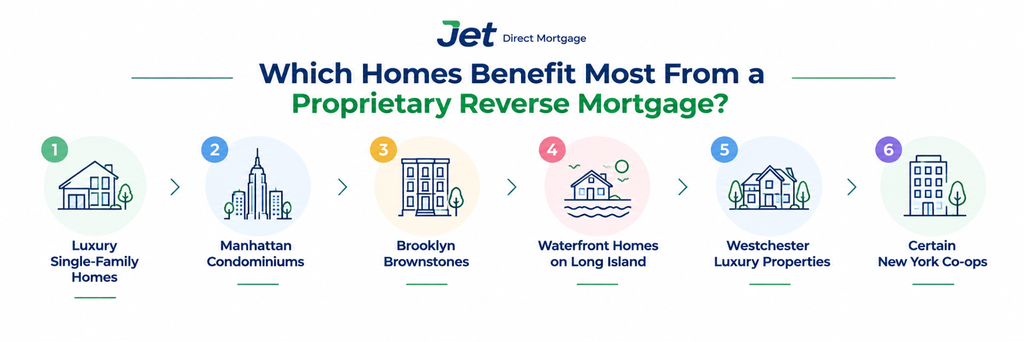
This is why proprietary reverse mortgages are often a better fit for owners of:
- Luxury homes
- High-value single-family homes
- Manhattan condominiums
- Brooklyn brownstones
- Waterfront homes on Long Island
- Certain New York co-ops offered through proprietary programs
If your property has appreciated significantly over the years, a proprietary reverse mortgage in New York may provide more financial flexibility than a traditional HECM by unlocking equity that would otherwise remain inaccessible under FHA loan limits.
Quick Tip
A higher home value doesn’t automatically mean you should choose a proprietary reverse mortgage. The best option depends on your home’s value, your borrowing goals, the amount of equity you’ve built, and how the loan terms compare with a standard HECM.
Comparing both options with an experienced reverse mortgage specialist is the best way to determine which loan delivers the greatest benefit for your situation.
How Much Can You Borrow With a Proprietary Reverse Mortgage?
One of the biggest reasons homeowners choose a proprietary reverse mortgage in New York is the ability to access more of their home’s value than may be possible with a traditional FHA-insured Home Equity Conversion Mortgage (HECM).
With a HECM, your borrowing amount isn’t based on your home’s full market value if it exceeds the FHA maximum claim amount. Instead, the loan calculation uses the lower of:
- Your home’s appraised value, or
- The FHA maximum claim amount.
A proprietary reverse mortgage works differently. Because it’s offered by a private lender rather than insured by the FHA, it isn’t bound by the federal lending cap.
Many proprietary programs are specifically designed for homeowners with high-value properties, allowing the lender to consider a much larger portion, or even the full appraised value, when determining your available loan amount.
Why Does This Matter?
Imagine two homeowners who are both:
- 75 years old
- Have no existing mortgage
- Live in New York
- Apply on the same day with similar interest rates
The only difference is the value of their homes.
- Homeowner A: Home worth $850,000
- Homeowner B: Home worth $2.5 million
A HECM may work well for the first homeowner because the property’s value falls within the range where the FHA calculation captures most of its value.
For the second homeowner, however, the calculation is limited by the FHA maximum claim amount. Even though the home is worth significantly more, the additional value above the FHA limit generally doesn’t increase the HECM loan amount.
A proprietary reverse mortgage in New York may allow that homeowner to unlock equity tied to the home’s higher value instead.
It’s Not Just About Home Value
Even with a proprietary reverse mortgage, lenders don’t simply lend a percentage of your home’s value. They’ll also consider several other factors, including:
- Your age (or the age of the youngest borrower)
- Your available home equity
- Current interest rates
- The property’s appraised value
- The lender’s underwriting guidelines
In general, older borrowers, homeowners with more equity, and those applying when interest rates are lower tend to qualify for higher principal limits because the lender expects the loan to remain outstanding for a shorter period.
Does a Proprietary Reverse Mortgage Always Let You Borrow More?
Not necessarily.
If your home’s value falls comfortably within the FHA lending limit, a HECM may provide very similar borrowing power while also offering federal insurance and standardized borrower protections.
However, if you own a luxury home, waterfront property, Manhattan condominium, Brooklyn brownstone, Westchester estate, or another high-value property, a proprietary reverse mortgage in New York may allow you to access significantly more equity than a HECM because it isn’t constrained by the FHA lending cap.
That’s why comparing both options is one of the smartest steps you can take before deciding which reverse mortgage best fits your financial goals.
Which Homes Benefit Most From a Proprietary Reverse Mortgage?
Not every homeowner needs a proprietary reverse mortgage in New York. If your home’s value falls comfortably within the FHA lending limit, a traditional HECM may provide everything you need.
However, if you own a higher-value property, a proprietary reverse mortgage can often provide greater borrowing potential by taking more of your home’s value into account. Here are some of the properties that most commonly benefit from a proprietary reverse mortgage.
1. Luxury Single-Family Homes
If your home has appreciated significantly over the years, you may have built millions of dollars in equity. A proprietary reverse mortgage allows many owners of luxury homes to unlock more of that equity than a standard HECM, providing additional funds for retirement, healthcare expenses, home renovations, or estate planning.
2. Manhattan Condominiums
Condominiums in Manhattan frequently exceed the FHA lending limit, particularly in neighborhoods such as the Upper East Side, Tribeca, SoHo, and the Upper West Side.
For owners of these higher-value properties, a proprietary reverse mortgage may provide substantially greater access to home equity.
3. Brooklyn Brownstones
Many brownstones purchased decades ago have appreciated dramatically in value.
Even homeowners with relatively modest retirement income may now own properties worth several million dollars, making a proprietary reverse mortgage an attractive option for accessing equity without selling the home.
4. Waterfront Homes on Long Island
Homes along the North Shore, South Shore, and the Hamptons often have values well above the limits of traditional reverse mortgage programs. A proprietary reverse mortgage may allow homeowners to convert more of that appreciation into available funds while continuing to live in the property.
5. Westchester Luxury Properties
Communities such as Scarsdale, Rye, Bronxville, and Larchmont are home to many properties whose values exceed FHA lending limits. For homeowners planning their retirement, a proprietary reverse mortgage may offer significantly more borrowing flexibility than a HECM.
6. Certain New York Co-ops
One of the unique advantages of some proprietary reverse mortgage programs is that they may finance eligible New York cooperative apartments, which generally aren’t eligible for FHA-insured HECMs.
This creates an opportunity for many New York homeowners who wouldn’t otherwise qualify for a traditional reverse mortgage. (Availability depends on the lender and the specific co-op.)
Quick Tip
A high-value home doesn’t automatically mean a proprietary reverse mortgage is the best choice. The ideal loan depends on your home’s value, available equity, borrowing goals, and the specific loan terms available.
Comparing a proprietary reverse mortgage with a HECM is the best way to determine which option provides the greatest financial benefit for your situation.
Proprietary Reverse Mortgage vs. Jumbo Reverse Mortgage: What’s the Difference?
If you’ve been researching reverse mortgages, you’ve probably seen both the terms proprietary reverse mortgage and jumbo reverse mortgage used interchangeably. While they often refer to the same type of loan, there is a small but important distinction.
A proprietary reverse mortgage is any reverse mortgage that’s offered by a private lender rather than insured by the Federal Housing Administration (FHA).
These loans are designed using the lender’s own guidelines instead of the standardized rules that apply to FHA-insured Home Equity Conversion Mortgages (HECMs).
According to the Consumer Financial Protection Bureau (CFPB), proprietary reverse mortgages are one of the three primary types of reverse mortgages available in the United States.
A jumbo reverse mortgage is simply a type of proprietary reverse mortgage that is specifically designed for higher-value homes. Because these loans aren’t subject to FHA lending limits, they may allow homeowners to access more equity than a standard HECM.
In practice, most lenders use the terms proprietary reverse mortgage and jumbo reverse mortgage to describe the same product.
How Do They Compare?
| Proprietary Reverse Mortgage | Jumbo Reverse Mortgage |
| Offered by a private lender | Usually offered by a private lender |
| Not FHA-insured | Not FHA-insured |
| Designed for homes above FHA lending limits | Designed for higher-value homes |
| Loan terms vary by lender | Loan terms vary by lender |
| May provide greater borrowing potential than a HECM | May provide greater borrowing potential than a HECM |
So, if you’re searching for a jumbo reverse mortgage in New York, you’re likely looking for a proprietary reverse mortgage in New York. The terminology may differ between lenders, but the goal is the same: helping homeowners with high-value properties unlock more of their available equity than may be possible with a traditional HECM.
Proprietary Reverse Mortgage vs. HECM: Which Is Better for High-Value Homes?
If your home is worth significantly more than the FHA lending limit, one of the biggest decisions you’ll face is whether to choose a proprietary reverse mortgage in New York or a traditional Home Equity Conversion Mortgage (HECM).
Neither loan is universally better. The right choice depends on your home’s value, how much equity you want to access, your long-term financial goals, and which loan features matter most to you.
The biggest difference is how each loan is structured. A HECM is insured by the Federal Housing Administration (FHA), meaning it follows standardized federal guidelines and includes consumer protections that are consistent across lenders.
A proprietary reverse mortgage, often marketed as a jumbo reverse mortgage, is offered by a private lender, allowing more flexibility in loan design and potentially higher borrowing limits for qualifying homeowners.
According to the Consumer Financial Protection Bureau, proprietary reverse mortgages are designed primarily for owners of higher-value homes whose borrowing needs may exceed what a HECM can provide.
Here’s a quick comparison:
| Feature | HECM | Proprietary (Jumbo) Reverse Mortgage |
| Backed by | FHA | Private lender |
| FHA lending limit | Yes | No |
| Designed for | Most homeowners | High-value homes |
| Mortgage insurance premium | Required | Typically not required |
| Loan guidelines | Standardized | Vary by lender |
| Borrowing potential | Limited by FHA rules | May be significantly higher |
| Eligible co-ops | Generally no | Some lenders may allow them |
A HECM remains an excellent option for many retirees because it offers strong federal consumer protections and works well for homes that fall within FHA lending limits.
However, if you own a luxury property, a multi-million-dollar home, or another high-value property, a proprietary reverse mortgage in New York may provide access to substantially more equity simply because it isn’t constrained by FHA lending limits.
That doesn’t automatically make a jumbo reverse mortgage the better choice. Proprietary loans vary from lender to lender, meaning interest rates, fees, payment options, and eligibility requirements aren’t standardized.
This makes comparing loan offers especially important before deciding which program best aligns with your financial goals.
Which Loan Is Right for You?
A HECM may be the better choice if you:
- Own a home within the FHA lending limit.
- Prefer a federally insured loan with standardized rules.
- Value the additional consumer protections offered by the FHA.
A proprietary reverse mortgage may be worth considering if you:
- Own a home that exceeds the FHA lending limit.
- Want to maximize the equity available from a high-value property.
- Own a qualifying New York co-op or another property that may not fit traditional HECM guidelines.
- Want to explore jumbo reverse mortgage options designed specifically for luxury homes.
Advantages of a Proprietary Reverse Mortgage in New York
For homeowners with high-value properties, a proprietary reverse mortgage in New York can offer several advantages that may not be available through a traditional HECM.
While the right loan depends on your individual situation, proprietary reverse mortgages, often referred to as jumbo reverse mortgages, are specifically designed to provide greater flexibility for homeowners whose properties exceed FHA lending limits.
1. Access More of Your Home Equity
The biggest advantage of a proprietary reverse mortgage is the ability to access equity that may not be available through a HECM. Because these loans aren’t restricted by FHA lending limits, homeowners with luxury or high-value properties may qualify for significantly higher loan proceeds.
For many New York homeowners, that additional borrowing capacity can mean hundreds of thousands of dollars in extra available funds, depending on the home’s value, available equity, age, and the lender’s guidelines.
2. No FHA Lending Limit
Unlike a HECM, a jumbo reverse mortgage isn’t capped by the FHA maximum claim amount. This allows private lenders to evaluate higher-value homes based on their own lending criteria rather than a government-imposed limit.
This is particularly beneficial in markets where home values have increased substantially, such as Manhattan, Brooklyn, Long Island, and Westchester County.
3. No FHA Mortgage Insurance Premium
HECM borrowers are required to pay both an upfront and ongoing FHA mortgage insurance premium (MIP). Proprietary reverse mortgages generally don’t require FHA mortgage insurance because they aren’t federally insured.
Depending on the lender and loan structure, this may reduce certain borrowing costs, although proprietary loans may have different fees or pricing that should be evaluated as part of the overall comparison.
4. More Flexibility for High-Value Properties
Many proprietary lenders offer loan programs specifically tailored for luxury homes and unique property types that may not fit within standard FHA guidelines.
Depending on the lender, this can include:
- Higher maximum home values
- Larger available loan amounts
- Financing for certain eligible New York co-ops
- More flexible underwriting for high-net-worth homeowners
Because proprietary reverse mortgages are privately designed, loan features and eligibility requirements vary from one lender to another.
5. Continue Living in the Home You Love
Like a HECM, a proprietary reverse mortgage in New York allows you to continue living in your home while converting part of your equity into available funds.
As long as you continue meeting the loan requirements, such as maintaining the property, paying property taxes, homeowners insurance, and any applicable HOA fees, you remain the homeowner and keep title to your property.
Find Out Whether a Proprietary Reverse Mortgage Is Right for Your Home
If you own a high-value property, a proprietary reverse mortgage in New York could allow you to access significantly more of your home’s equity than a traditional HECM.
While both loan types let you convert home equity into tax-free loan proceeds without selling your home or making monthly mortgage payments, proprietary reverse mortgages are specifically designed for homeowners whose properties exceed FHA lending limits.
The right choice depends on several factors, including your home’s value, available equity, age, financial goals, and the features that matter most to you.
For some homeowners, a federally insured HECM provides everything they need. For others, a jumbo reverse mortgage may unlock substantially greater borrowing potential and offer more flexibility for luxury properties and certain New York co-ops.
At Jet Direct Mortgage, we help homeowners compare both options side by side so you can make an informed decision based on your unique circumstances, not guesswork.
Ready to see which reverse mortgage offers you the greatest benefit? Contact Jet Direct Mortgage today for a personalized consultation and discover whether a proprietary reverse mortgage is the right fit for your retirement goals.
Frequently Asked Questions
What is a proprietary reverse mortgage?
A proprietary reverse mortgage is a reverse mortgage offered by a private lender rather than insured by the Federal Housing Administration (FHA). It’s designed primarily for homeowners with higher-value properties and may allow you to borrow more than a standard HECM because it isn’t subject to FHA lending limits.
Is a proprietary reverse mortgage the same as a jumbo reverse mortgage?
In most cases, yes. The terms proprietary reverse mortgage and jumbo reverse mortgage are commonly used interchangeably. Both describe privately funded reverse mortgages designed for higher-value homes that exceed FHA lending limits.
Who qualifies for a proprietary reverse mortgage in New York?
Qualification requirements vary by lender, but most homeowners must meet minimum age requirements, own a primary residence with substantial home equity, complete a financial assessment, and have an eligible property. Some proprietary reverse mortgage programs also finance certain New York co-ops that aren’t eligible for FHA-insured HECMs.
How much can I borrow with a proprietary reverse mortgage?
The amount you can borrow depends on your age, your home’s appraised value, your available equity, current interest rates, and the lender’s guidelines. Because proprietary reverse mortgages aren’t limited by FHA lending caps, homeowners with high-value properties may qualify for significantly larger loan amounts than with a traditional HECM.
What’s the difference between a proprietary reverse mortgage and a HECM?
A HECM is insured by the FHA and follows standardized federal guidelines, while a proprietary reverse mortgage is offered by a private lender with its own underwriting criteria. Proprietary reverse mortgages generally serve homeowners with higher-value homes and may provide greater borrowing potential than a HECM.
Are proprietary reverse mortgages FHA-insured?
No. A proprietary reverse mortgage is not backed by the FHA. Instead, it’s funded and administered by a private lender, which means loan terms, borrowing limits, and eligibility requirements may differ from one lender to another.
Can I get a proprietary reverse mortgage on a New York co-op?
Potentially, yes. Unlike FHA-insured HECMs, some proprietary reverse mortgage programs are available for eligible New York cooperative apartments. Availability depends on the lender, the co-op’s requirements, and your qualifications.
Do proprietary reverse mortgages have loan limits?
There is no FHA lending limit for proprietary reverse mortgages. Instead, each lender establishes its own maximum loan amounts, making these loans particularly attractive for homeowners with luxury or high-value properties.
Do I have to make monthly mortgage payments?
No. Like a HECM, a proprietary reverse mortgage doesn’t require monthly principal and interest payments as long as you continue living in the home as your primary residence and meet your ongoing obligations, including paying property taxes, homeowners insurance, and maintaining the property.
Is a proprietary reverse mortgage a good option for luxury homes?
It can be. If your home’s value exceeds FHA lending limits, a proprietary reverse mortgage in New York may allow you to access more of your available equity than a traditional HECM. It’s often an attractive solution for owners of luxury homes, waterfront properties, Manhattan condominiums, Brooklyn brownstones, and other high-value real estate.
Can I refinance my HECM into a proprietary reverse mortgage?
Yes, in some situations. If your home’s value has increased substantially since you obtained your HECM, refinancing into a proprietary (jumbo) reverse mortgage may allow you to access additional equity. Before refinancing, it’s important to compare the potential benefits, loan costs, and available proceeds to determine whether the transaction makes financial sense.
Will I still own my home?
Yes. With a proprietary reverse mortgage, you remain the owner of your home and continue to hold title. As long as you meet the loan requirements, including living in the property as your primary residence and paying property taxes, homeowners insurance, and any applicable HOA fees, you can continue living in your home for as long as you choose.

Experienced Chief Operating Officer with a 26 + year demonstrated history of working in the banking industry. Skilled in all aspects of the residential mortgage market . Strong business development professional with a Bachelor of Science (BS) focused in Business Administration and Management, from St. Joseph College. A direct endorsement underwriter and a licensed Mortgage Loan Originator.