If you are wondering how to apply for a reverse mortgage in New York, you’re not alone. Many homeowners have built substantial equity over the years and are looking for ways to access that wealth without selling their home.
Whether you’re planning for retirement, covering everyday expenses, paying off an existing mortgage, or creating a financial cushion for the future, a reverse mortgage may be an option worth exploring.
Unlike a traditional mortgage, a reverse mortgage allows eligible homeowners to convert a portion of their home equity into available funds while continuing to live in their home.
Because of how these loans work, they’re often misunderstood. Some people believe they give up ownership of their home, while others assume reverse mortgages are only for homeowners facing financial hardship. In reality, neither is necessarily true.
If you’re researching how to apply for a reverse mortgage in New York, it’s important to understand how the program works, who qualifies, the costs involved, and both the advantages and potential drawbacks before making a decision. Every homeowner’s financial goals are different, and a reverse mortgage may be the right solution for some, but not for others.
At Jet Direct Mortgage, we believe the best financial decisions begin with clear, unbiased information. That’s why we’ve created this comprehensive guide, to help you understand how reverse mortgages work, answer the most common questions homeowners have, and provide the knowledge you need to decide whether a reverse mortgage aligns with your retirement and homeownership goals in New York.
What Is a Reverse Mortgage in New York?
A reverse mortgage in New York is a type of home loan that allows eligible homeowners to convert a portion of their home equity into available funds without selling their home or taking on the monthly mortgage payments typically associated with a traditional loan.
Instead of making payments to the lender each month, the loan balance generally increases over time as interest and applicable fees accrue.
One of the most important things to understand is that a reverse mortgage isn’t the same as giving up ownership of your home. As long as you continue to meet the loan obligations, such as living in the property as your primary residence, maintaining the home, and paying property taxes and homeowners insurance, you remain the owner of your home.
Most reverse mortgages are offered through the Home Equity Conversion Mortgage (HECM) program, which is insured by the Federal Housing Administration (FHA).
These loans are specifically designed for older homeowners who want to use the equity they’ve built over many years to supplement retirement income, cover healthcare expenses, eliminate an existing mortgage payment, finance home improvements, or simply create additional financial flexibility.
Unlike a conventional mortgage, where your loan balance decreases as you make monthly payments, a reverse mortgage generally works in the opposite direction. The amount you owe increases over time because you’re receiving funds from your available home equity rather than paying down the principal each month.
The loan typically becomes due when the last eligible borrower permanently moves out of the home, sells the property, or passes away. At that point, the home is usually sold to repay the loan, although heirs may have other options depending on their circumstances and the applicable loan guidelines.
How Does a Reverse Mortgage Differ From a Traditional Mortgage?
| Traditional Mortgage | Reverse Mortgage |
| You make monthly payments to the lender. | You generally don’t make monthly mortgage payments to the lender.* |
| Your loan balance decreases over time. | Your loan balance generally increases over time. |
| You borrow money to purchase or refinance a home. | You borrow against the equity you’ve already built in your home. |
| Monthly payments are typically required. | Funds may be received as a lump sum, monthly payments, a line of credit, or a combination of payment options. |
| The loan is typically repaid over time through monthly payments. | The loan is generally repaid when the home is sold, the borrower permanently moves out, or the last borrower passes away. |
*Borrowers must still continue to meet the loan obligations, including paying property taxes, homeowners insurance, maintaining the property, and complying with the terms of the loan agreement.
Although a reverse mortgage in New York can provide valuable financial flexibility during retirement, it’s not the right solution for every homeowner. Understanding how the loan works is the first step toward deciding whether it aligns with your long-term financial goals.
In the next section, we’ll walk through how to apply for a reverse mortgage in New York, including each step of the process, the documents you’ll need, and what you can expect from application to closing.
But before that, there is one more thing that we need to make clear:
Who Can Apply for a Reverse Mortgage in New York?
If you’re researching how to apply for a reverse mortgage in New York, one of the first questions you’ll likely ask is whether you’re eligible. While reverse mortgages are designed to help older homeowners access the equity they’ve built over time, not everyone will qualify.
Your lender will evaluate several factors before approving your application, including your age, home equity, property type, financial obligations, and whether the home is your primary residence.
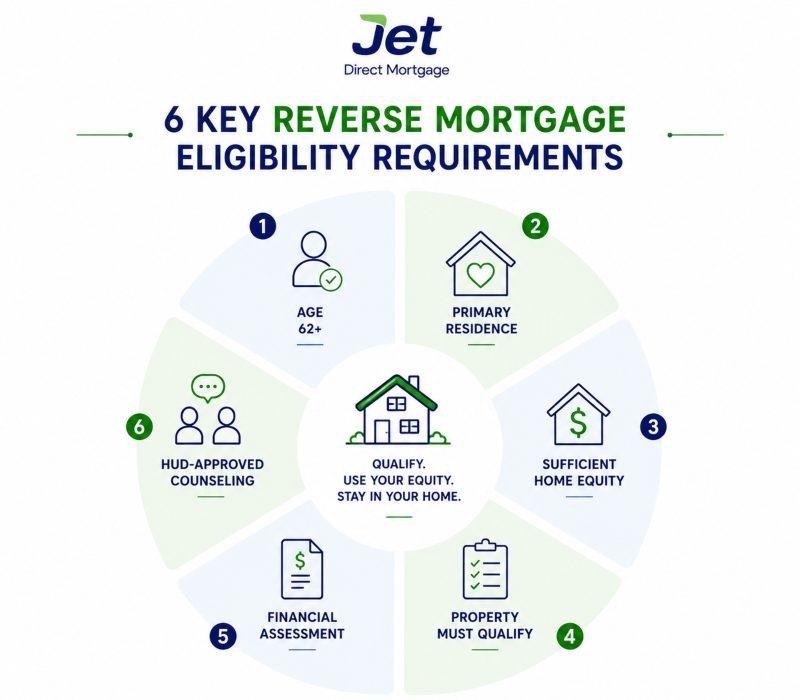
Below are the main eligibility requirements you’ll need to meet before you can apply for a reverse mortgage in New York.
1. Age Requirement
To qualify for a federally insured Home Equity Conversion Mortgage (HECM), the youngest borrower listed on the loan must generally be at least 62 years old. This age requirement is established by the FHA and applies regardless of how much equity you’ve accumulated.
If you’re married and one borrower is younger than 62, it’s important to discuss your options with your lender, as special rules may apply depending on your circumstances.
2. Your Home Must Be Your Primary Residence
Reverse mortgages are intended for homeowners who live in the property as their primary residence. This means you must occupy the home for the majority of the year.
Vacation homes, second homes, and most investment properties generally do not qualify for a reverse mortgage. If you permanently move out of the property, the loan will typically become due according to the terms of the agreement.
3. You Need Sufficient Home Equity
One of the biggest factors affecting your eligibility is the amount of equity you’ve built in your home.
While there isn’t a single percentage that guarantees approval, borrowers with more home equity generally have access to more borrowing power. If you still have an existing mortgage, it may still be possible to qualify, provided enough equity remains to satisfy the program requirements.
The amount you may be eligible to receive depends on several factors, including:
- Your age
- Your home’s appraised value
- Current interest rates
- Applicable FHA lending limits
- The amount of any existing mortgage balance
4. Your Property Must Meet Program Requirements
Not every property qualifies for a reverse mortgage. Eligible properties commonly include:
- Single-family homes
- FHA-approved condominiums
- Certain multi-unit properties where you occupy one of the units
- Eligible manufactured homes that meet FHA requirements
Your lender will also arrange for a professional appraisal to determine the property’s current market value and confirm that it meets the necessary property standards.
5. Financial Assessment
Although reverse mortgages generally don’t require borrowers to demonstrate income in the same way as a traditional mortgage, lenders are still required to complete a financial assessment.
The purpose of this review is to determine whether you’re likely to continue meeting your ongoing homeowner obligations after receiving the loan. During this assessment, your lender may review:
- Your income sources
- Your monthly financial obligations
- Your credit history
- Your payment history for property taxes and homeowners insurance
- Any outstanding federal debt
This assessment helps protect both the borrower and the lender by ensuring the loan remains sustainable over the long term.
6. HUD-Approved Counseling Is Required
Before you can complete the application process, you’ll generally be required to participate in a counseling session with a HUD-approved reverse mortgage counselor.
This independent counseling session is designed to ensure you fully understand:
- How a reverse mortgage works
- Your rights and responsibilities as a borrower
- The costs associated with the loan
- Available alternatives
- The long-term impact on your home equity and estate
After completing the session, you’ll receive a counseling certificate, which is required before your lender can move forward with your reverse mortgage application.
Understanding these eligibility requirements is an important first step before learning how to apply for a reverse mortgage in New York. Once you’ve confirmed that you qualify, you can begin preparing your documents and working through the application process with your mortgage banker.
How to Apply for a Reverse Mortgage in New York: Step-by-Step
If you’re wondering how to apply for a reverse mortgage in New York, understanding the process ahead of time can help you avoid unnecessary delays and make informed decisions throughout your application.
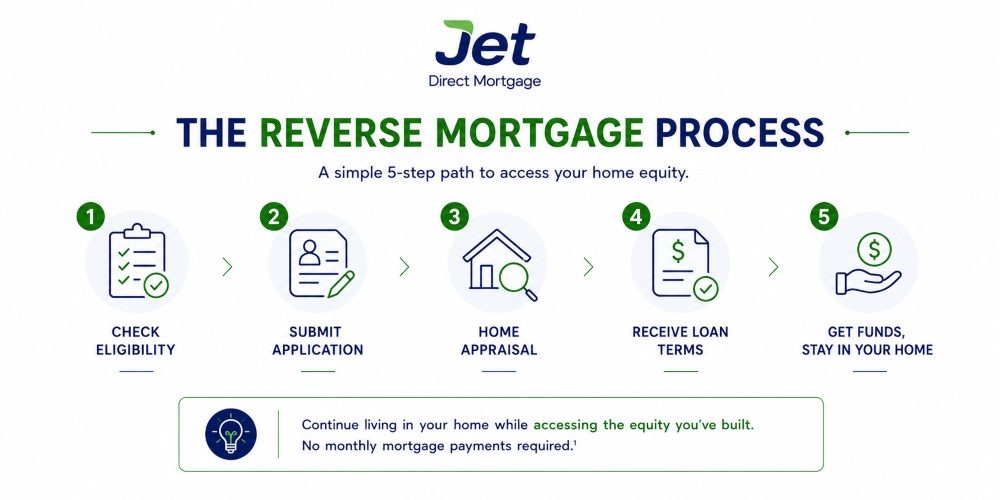
While every borrower’s situation is unique, most reverse mortgage applications follow the same general process. From confirming your eligibility and completing the required counseling session to gathering documents, ordering the appraisal, and closing on the loan, each step plays an important role in determining whether your application is approved.
The complete process typically takes 30 to 60 days, although the timeline can vary depending on factors such as how quickly documentation is provided, whether additional information is requested during underwriting, the appraisal timeline, and the complexity of the property or title.
Below, we’ll walk you through each stage of the application process so you’ll know exactly what to expect.
Step 1: Schedule a Consultation and Review Your Eligibility
The first step in learning how to apply for a reverse mortgage in New York is determining whether a reverse mortgage is the right financial solution for your situation. Although you may already meet the basic eligibility requirements, your initial consultation is about much more than simply confirming your age or the amount of equity in your home.
During this stage, your mortgage banker will take the time to understand your financial goals, explain how reverse mortgages work, answer your questions, and determine whether the loan aligns with your long-term plans.
For many homeowners, this is also the opportunity to compare a reverse mortgage with other options, such as a home equity loan, HELOC, cash-out refinance, or downsizing. A reverse mortgage can provide valuable financial flexibility, but it’s important to understand both the benefits and the long-term responsibilities before moving forward.
During your consultation, you’ll typically discuss:
- Your age and borrower eligibility
- Whether the home is your primary residence
- Approximately how much equity you’ve built
- Any existing mortgage balance
- Your financial goals and how you plan to use the funds
- The different payment options available, including a lump sum, line of credit, monthly payments, or a combination of these
Your mortgage banker will also explain the basic costs associated with the loan, including closing costs, mortgage insurance premiums for FHA-insured HECM loans, servicing fees (when applicable), and other expenses that may be financed into the loan rather than paid out of pocket.
What Information Should You Have Ready?
Although you won’t need to provide every document during your first conversation, having the following information available can make your consultation much more productive:
| Information | Why It’s Important |
| Your age (and your spouse’s age, if applicable) | Determines basic HECM eligibility and helps estimate available loan proceeds. |
| Estimated home value | Helps estimate how much equity may be available. |
| Current mortgage balance | Determines whether enough equity exists after paying off any existing loan. |
| Property type | Confirms whether the home may qualify under FHA guidelines. |
| Property tax and homeowners insurance status | These obligations must continue throughout the life of the reverse mortgage. |
| Your retirement goals | Helps determine whether a reverse mortgage fits your overall financial strategy. |
This initial consultation doesn’t obligate you to move forward with the loan. Instead, it’s designed to give you a clear understanding of your options so you can decide whether continuing the application process makes sense for your financial situation.
Once you’ve confirmed that a reverse mortgage is a good fit, the next step is completing the required HUD-approved counseling session, one of the most important consumer protections built into the reverse mortgage process.
Step 2: Complete the Required HUD-Approved Counseling Session
One of the most important steps in learning how to apply for a reverse mortgage in New York is completing a counseling session with a HUD-approved Home Equity Conversion Mortgage (HECM) counselor.
Unlike many other mortgage products, this counseling session isn’t optional for FHA-insured reverse mortgages. It’s a federal requirement designed to protect homeowners by ensuring they fully understand how a reverse mortgage works before committing to the loan.
The counseling session is conducted by an independent HUD-approved housing counseling agency, not by your lender or mortgage banker. This independence is intentional; it ensures you’ll receive objective information about reverse mortgages, alternative financial options, your responsibilities as a borrower, and the long-term impact the loan may have on your finances and estate.
HUD-approved counselors are listed on FHA’s official HECM Counselor Roster and may provide counseling either by telephone or in person.
Although Jet Direct Mortgage can explain the reverse mortgage process, answer general questions, and help you prepare for the application, we cannot conduct the required counseling session. Instead, we’ll help you locate a qualified HUD-approved counselor so you can complete this important step as efficiently as possible.
HUD also allows borrowers to search the official HECM Counselor Roster or call (800) 569-4287 to locate an approved counselor.
What You’ll Learn During the Counseling Session
The counseling session is intended to ensure you’re making an informed financial decision, not to convince you to move forward with a reverse mortgage.
Topics typically include:
- How a reverse mortgage works
- Your financial responsibilities after closing
- Available payment options
- The costs and fees associated with the loan
- How interest accrues over time
- The effect on your remaining home equity
- How the loan may affect your heirs
- Alternatives to a reverse mortgage, such as downsizing, refinancing, or a home equity loan
- What happens if you permanently move out of your home
The counselor will also encourage you to ask questions about your personal situation so you fully understand both the advantages and the potential drawbacks before proceeding. HUD counseling is specifically designed to help borrowers make their own informed decisions, not to recommend any particular lender or loan product.
How Long Does the Counseling Session Take?
Most counseling sessions last approximately 60 to 90 minutes, although the exact length depends on your financial situation and the number of questions you have.
Before the session, you’ll usually receive educational materials to review. Taking time to read these documents beforehand can help you better understand the discussion and make the most of your appointment.
What Happens After Counseling?
Once you’ve completed the session, the counselor will issue a HECM Counseling Certificate.
This certificate doesn’t guarantee loan approval, nor does it obligate you to move forward with a reverse mortgage. Instead, it confirms that you’ve completed the required counseling and understand the fundamentals of the program. Your lender will need a copy of this certificate before processing your reverse mortgage application.
For many homeowners, the counseling session provides peace of mind. It offers an opportunity to ask questions, better understand the loan, and confirm that applying for a reverse mortgage is the right decision before moving on to the next step: gathering the documents needed to complete your application.
Step 3: Gather the Documents You’ll Need
After confirming your eligibility, the next step in how to apply for a reverse mortgage in New York is preparing the documentation your lender will use to process your application.
Although reverse mortgages don’t require you to make monthly mortgage payments, they still involve a thorough review of your identity, property, and financial situation. Having your paperwork organized before you apply can significantly reduce delays and help your lender move your application through underwriting more efficiently.
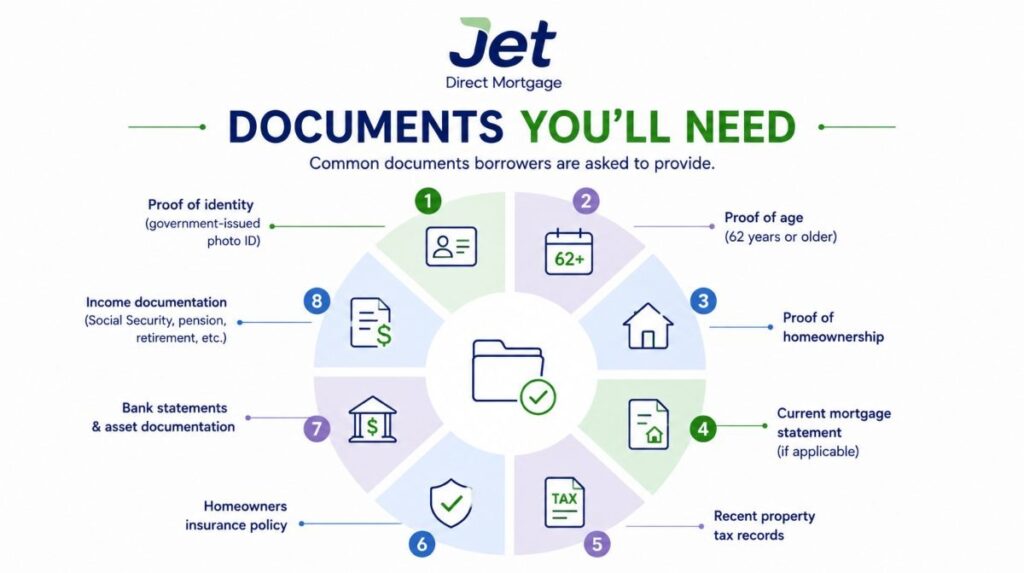
While the exact documentation varies depending on your circumstances, most borrowers are asked to provide the following:
- Proof of identity, such as a valid driver’s license, passport, or other government-issued photo ID.
- Proof of age, since borrowers generally must be at least 62 years old to qualify for a federally insured HECM reverse mortgage.
- Proof of homeownership, including your property deed or other ownership records.
- A current mortgage statement, if you still have an outstanding mortgage, so your lender can determine the remaining payoff amount.
- Recent property tax records to verify that your taxes are current.
- Your homeowners insurance policy to confirm the property is adequately insured.
- Bank statements and, when requested, documentation showing your available assets.
- Income documentation, such as Social Security benefit letters, pension statements, retirement account distributions, or other recurring income sources.
Depending on your financial situation or the type of property you own, your lender may also request additional documentation. For example, if your home is owned by a trust, recently inherited, or has multiple owners on the title, additional legal documents may be needed before the loan can move forward.
Why Does Your Lender Need These Documents?
Many homeowners are surprised by the amount of documentation involved in a reverse mortgage application. However, each document serves a specific purpose.
Your lender uses this information to:
- Verify your identity and confirm you meet the program’s age requirement.
- Confirm that you legally own the property.
- Determine whether any existing mortgage must be paid off at closing.
- Complete the required financial assessment.
- Ensure the property meets program requirements.
- Identify potential title or ownership issues before closing.
Missing or incomplete documentation is one of the most common reasons mortgage applications are delayed. Taking the time to gather everything in advance can help keep the process on schedule and reduce requests for additional information later.
Once your documents have been submitted and reviewed, your lender can begin processing your application and order a professional appraisal to determine your home’s current market value, the next major step in how to apply for a reverse mortgage in New York.
Step 4: Submit Your Reverse Mortgage Application
With your eligibility confirmed, counseling completed, and documents prepared, you’re ready to officially begin how to apply for a reverse mortgage in New York by submitting your loan application.
During this stage, your mortgage banker will collect your documentation, review your financial information, explain your available loan options, and complete the official reverse mortgage application. Although much of the paperwork is similar to a traditional mortgage, the focus is different.
Rather than determining whether you can afford monthly mortgage payments, the lender is evaluating your eligibility for the reverse mortgage program and completing the financial assessment required for federally insured Home Equity Conversion Mortgages (HECMs).
This is also the stage where many homeowners receive their first personalized estimate of how much they may be eligible to borrow.
What Happens During the Application?
Your lender will carefully review the information you’ve provided to verify that it is complete and accurate before sending the file to processing. During this stage, your mortgage banker will typically:
- Review your completed application with you.
- Verify your identity and ownership of the property.
- Confirm your existing mortgage balance, if applicable.
- Review your financial documents and supporting paperwork.
- Explain the different reverse mortgage payment options available.
- Discuss estimated closing costs, interest rates, and applicable FHA mortgage insurance premiums.
- Answer any remaining questions before your application moves to the next stage.
If any information is missing or additional documentation is required, your lender will usually notify you immediately so the issue can be resolved before underwriting begins.
Choosing How You Want to Receive Your Funds
One of the most important decisions you’ll make during the application process is how you want to receive your reverse mortgage proceeds. The right option depends on your financial goals, retirement plans, and how you expect to use the funds.
Depending on the reverse mortgage program, you may be able to receive your proceeds as:
- A lump sum, often chosen by homeowners who want to pay off an existing mortgage or cover a major expense.
- Monthly payments, providing a predictable source of supplemental retirement income.
- A line of credit, allowing you to access funds only when you need them.
- A combination of payment options, offering greater flexibility as your financial needs change over time.
Your mortgage banker will explain the advantages of each option and help you determine which structure best aligns with your long-term financial objectives.
How Long Does This Step Take?
For most borrowers, completing and submitting the application takes one to two appointments, depending on how quickly the required documents are provided and whether additional information is needed.
Submitting your application doesn’t mean you’ve been approved yet. Your lender must still verify the property’s value through a professional appraisal and complete the underwriting process before the loan can move to closing.
Once your application has been accepted, the next major step in how to apply for a reverse mortgage in New York is scheduling a professional home appraisal to determine your property’s current market value and calculate the maximum amount you may be eligible to borrow.
Step 5: Complete the Home Appraisal
Once you’ve submitted your application, your lender will order a professional home appraisal. This step is essential in how to apply for a reverse mortgage in New York, as the appraised value of your home helps determine how much you may be eligible to borrow.
An independent, licensed appraiser will evaluate your property’s market value based on factors such as its size, condition, location, recent comparable sales, and any upgrades or renovations. The appraiser will also confirm that the home meets FHA minimum property standards for safety and livability.
During the appraisal, the appraiser typically reviews:
- The home’s overall condition
- Recent renovations or improvements
- Comparable home sales in your area
- Any health or safety concerns
- Structural, roofing, plumbing, and electrical systems
The inspection usually takes 30 to 90 minutes, and the appraisal report is often completed within 5 to 10 business days, depending on the local market.
If the appraiser identifies any issues that don’t meet FHA requirements, repairs may be required before the loan can move forward. Once the appraisal is complete, your file moves to underwriting for the final review and approval process.
Step 6: Underwriting and Final Loan Approval
After your appraisal has been completed, your application moves into underwriting. This is the stage where your lender performs a final review to verify that you meet all program requirements before issuing the final loan approval.
During underwriting, the lender reviews every part of your application, including your eligibility, financial assessment, property appraisal, title information, and supporting documentation. If any information is missing or needs clarification, your mortgage banker will contact you to request additional documents.
The underwriter will typically verify:
- Your completed loan application
- The home appraisal and property eligibility
- Your financial assessment
- Your existing mortgage payoff amount (if applicable)
- Property taxes and homeowners insurance
- The property’s title to ensure there are no outstanding ownership issues
It’s common for the underwriter to issue “conditions,” which are requests for additional documentation before the loan can be approved. These may include updated bank statements, clarification on a financial transaction, or additional information about the property. Responding quickly to these requests can help keep your application on schedule.
For most reverse mortgages, underwriting is completed within a few business days to two weeks, depending on the complexity of the application and how quickly any outstanding conditions are satisfied.
Once all conditions have been cleared, your lender will issue the final loan approval and prepare your closing documents, bringing you one step closer to completing the reverse mortgage process.
Step 7: Review Your Closing Disclosure and Sign the Loan Documents
Once your reverse mortgage has received final approval, your lender will prepare your closing documents and schedule a closing date. This is one of the final steps in how to apply for a reverse mortgage in New York, giving you the opportunity to review all of the loan terms before officially completing the transaction.
Before closing, you’ll receive a Closing Disclosure, which outlines the final details of your reverse mortgage. This document includes important information such as:
- Your available loan proceeds
- Your selected payment option
- Interest rate and applicable fees
- Closing costs
- Mortgage insurance premiums (for HECM loans)
- Any existing mortgage balance that will be paid off at closing
Take the time to review these documents carefully and ask your mortgage banker about anything you don’t fully understand. It’s important that you’re comfortable with every aspect of the loan before signing.
On closing day, you’ll sign the final loan documents, and any existing mortgage on the property will typically be paid off using the reverse mortgage proceeds. If you’re obtaining a federally insured HECM reverse mortgage, you’ll also have a three-business-day right of rescission, allowing you to cancel the loan without penalty if you change your mind after closing.
Once this rescission period has expired, your loan will be funded, and you’ll move to the final step: receiving your reverse mortgage proceeds according to the payment option you selected.
Step 8: Receive Your Funds and Manage Your Reverse Mortgage Responsibly
After you’ve signed the closing documents and any applicable waiting periods have passed, the final step in how to apply for a reverse mortgage in New York is receiving your loan proceeds.
Depending on the payment option you selected during the application process, your funds may be distributed as:
- A lump sum for larger one-time expenses or to pay off an existing mortgage.
- Monthly payments to supplement your retirement income.
- A line of credit that you can access when needed.
- A combination of payment options for greater financial flexibility.
Your mortgage banker will explain when you can expect to receive your funds and how your chosen payment option will work over time.
Your Responsibilities Don’t End at Closing
Although reverse mortgages generally don’t require monthly mortgage payments, you still have important responsibilities as a homeowner. To keep your loan in good standing, you’ll generally need to:
- Continue living in the home as your primary residence.
- Pay your property taxes on time.
- Maintain homeowners insurance.
- Keep the property in good condition.
- Comply with the terms of your loan agreement.
Failing to meet these obligations could cause the loan to become due, even if you’re still living in the home.
Receiving your funds marks the end of the application process, but it’s also the beginning of a long-term financial decision. By understanding your responsibilities and working with an experienced mortgage banker, you can make the most of your reverse mortgage while continuing to enjoy your home with greater financial confidence.
How to Apply for a Reverse Mortgage in New York
Applying for a reverse mortgage doesn’t have to be overwhelming. By understanding each stage of the process, from confirming your eligibility and completing HUD counseling to gathering your documents, completing the appraisal, and closing on the loan, you can approach your application with confidence and avoid many of the common delays homeowners encounter.
If you’re considering how to apply for a reverse mortgage in New York, the most important first step is working with an experienced mortgage banker who can explain your options, answer your questions, and guide you through every stage of the process. At Jet Direct Mortgage, we’re committed to making the reverse mortgage process as straightforward and transparent as possible, helping you determine whether it’s the right solution for your retirement goals and financial future.
Are you ready to get started? Apply now!
Frequently Asked Questions
How do I apply for a reverse mortgage in New York?
To apply for a reverse mortgage in New York, you’ll typically begin by speaking with a mortgage banker to review your eligibility. From there, you’ll complete a required HUD-approved counseling session, gather your documents, submit your application, complete a home appraisal, go through underwriting, attend your closing, and receive your funds once the loan is finalized.
What are the requirements to apply for a reverse mortgage in New York?
Generally, you must be at least 62 years old, live in the home as your primary residence, have sufficient home equity, complete HUD-approved counseling, and meet the lender’s financial assessment requirements.
How long does it take to apply for a reverse mortgage in New York?
While every application is different, the entire process typically takes 30 to 60 days from your initial consultation to closing. The timeline may vary depending on the appraisal, underwriting, and how quickly requested documents are provided.
Do I have to complete HUD counseling before applying?
Yes. For federally insured Home Equity Conversion Mortgages (HECMs), HUD-approved counseling is required before your lender can move forward with the application. The counseling session helps ensure you understand how the loan works, your responsibilities, and the alternatives available.
What documents do I need to apply for a reverse mortgage?
Most lenders will ask for a government-issued photo ID, proof of age, proof of homeownership, a current mortgage statement (if applicable), property tax records, homeowners insurance information, bank statements, and documentation of your income and assets.
Will I need a home appraisal?
Yes. An independent appraisal is required to determine your home’s current market value and confirm that it meets FHA property standards. The appraisal also helps determine the maximum amount you may be eligible to borrow.
Do I still own my home after getting a reverse mortgage?
Yes. You remain the owner of your home throughout the life of the reverse mortgage, provided you continue to meet the loan obligations, including living in the home as your primary residence, maintaining the property, and paying property taxes and homeowners insurance.
Can I apply for a reverse mortgage if I still have a mortgage?
Yes. Many homeowners apply for a reverse mortgage while they still have an existing mortgage. In most cases, the reverse mortgage proceeds are first used to pay off the remaining mortgage balance, provided sufficient home equity is available.
How are reverse mortgage funds paid?
Depending on the loan program and your financial goals, you may receive your funds as a lump sum, monthly payments, a line of credit, or a combination of these payment options.
Why should I work with Jet Direct Mortgage?
At Jet Direct Mortgage, we take the time to explain every step of how to apply for a reverse mortgage in New York, answer your questions, and guide you through the process from your initial consultation to closing. Our goal is to help you make an informed decision and choose the financing solution that best supports your retirement and homeownership goals.

Experienced Chief Operating Officer with a 26 + year demonstrated history of working in the banking industry. Skilled in all aspects of the residential mortgage market . Strong business development professional with a Bachelor of Science (BS) focused in Business Administration and Management, from St. Joseph College. A direct endorsement underwriter and a licensed Mortgage Loan Originator.