Wondering how much you can get from a reverse mortgage in New York? Learn how loan amounts are calculated, what factors affect your eligibility, and estimate your available proceeds.
If you’re wondering how much you can get from a reverse mortgage in New York, you’re asking one of the most important, and most common, questions homeowners have before exploring this type of loan.
The answer isn’t the same for everyone. Unlike a traditional mortgage, where your loan amount is largely determined by your income and borrowing capacity, a reverse mortgage is based primarily on your home’s equity and several other factors unique to your situation.
In general, homeowners who are older, have more equity, and own higher-value homes may qualify for larger loan amounts. According to the Consumer Financial Protection Bureau (CFPB), these are the primary factors lenders use to determine your available reverse mortgage proceeds.
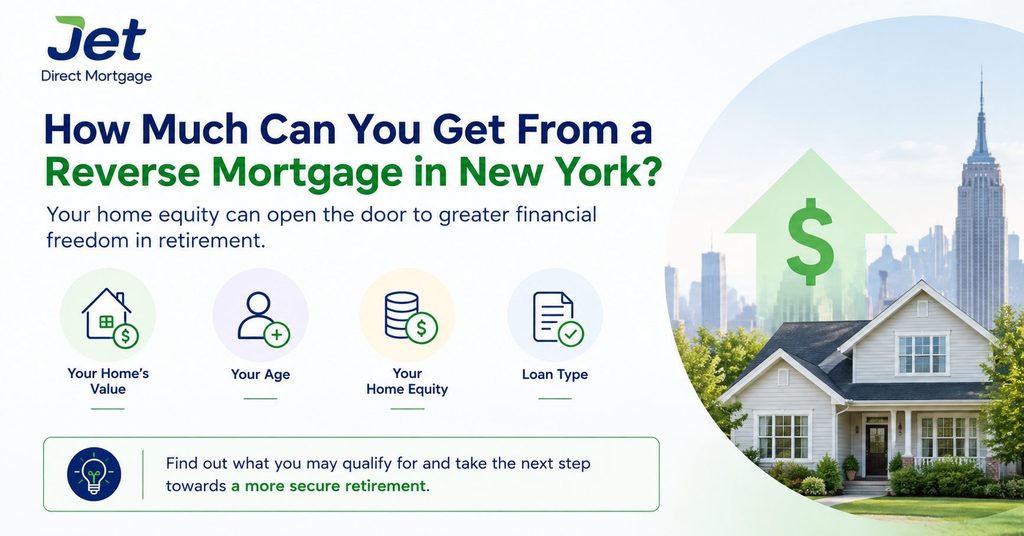
The amount you receive can range from tens of thousands to several hundred thousand dollars, depending on your individual circumstances. If you own a higher-value home in New York, you may even qualify for a proprietary (jumbo) reverse mortgage, which can provide access to more equity than a standard FHA-insured HECM loan.
In this guide, you’ll learn exactly how much you can get from a reverse mortgage in New York, how lenders calculate your available loan amount, what factors have the biggest impact on your proceeds, and how to estimate what you may qualify for before you apply.
The Short Answer: How Much Can You Get From a Reverse Mortgage in New York?
If you’re wondering how much you can get from a reverse mortgage in New York, most homeowners can typically borrow between 40% and 70% of their home’s appraised value.
The exact amount depends on your age, available home equity, current interest rates, your existing mortgage balance, and whether you choose an FHA-insured HECM or a proprietary reverse mortgage.
For example:
- A homeowner with a $500,000 home may qualify for approximately $200,000 to $350,000.
- A homeowner with a $750,000 home may qualify for approximately $300,000 to $525,000.
- A homeowner with a $1 million home may qualify for approximately $400,000 to $700,000, depending on the loan program and eligibility.
Keep in mind that if you still have an existing mortgage, part of your reverse mortgage proceeds will first be used to pay off that balance before you receive the remaining funds.
According to the Consumer Financial Protection Bureau (CFPB), your age, home value, current interest rates, and outstanding mortgage balance are the primary factors used to calculate how much you can get from a reverse mortgage in New York.
How Are Reverse Mortgage Loan Amounts Calculated?
When you apply for a reverse mortgage in New York, the lender doesn’t simply lend you a fixed percentage of your home’s value. Instead, they calculate what’s called your principal limit, which is the maximum amount you may be eligible to borrow.
The calculation follows a straightforward process:
- Determine your home’s value. For a HECM, the calculation uses the lower of your home’s appraised value or the FHA maximum claim amount. In 2026, the FHA lending limit is $1,249,125.
- Apply aPrincipal Limit Factor(PLF). The FHA publishes Principal Limit Factors based primarily on the age of the youngest borrower and the expected interest rate. As a general rule:
- The older you are, the higher your Principal Limit Factor.
- The lower the interest rate, the higher your Principal Limit Factor.
- Subtract mandatory obligations. Before you receive any funds, the lender typically deducts:
- Your existing mortgage balance
- Closing costs and financed fees
- Any required set-asides (if applicable)
The remaining amount is the money available to you through a lump sum, monthly payments, a line of credit, or a combination of these payment options.
To give you an idea of how age affects borrowing, HUD’s published Principal Limit Factors show that, at an expected interest rate of 5.5%, a 65-year-old has a Principal Limit Factor of approximately 40.3%, a 75-year-old about 46.7%, and an 85-year-old about 57.0%.
In other words, older homeowners generally qualify to borrow a larger percentage of their home’s value than younger homeowners.
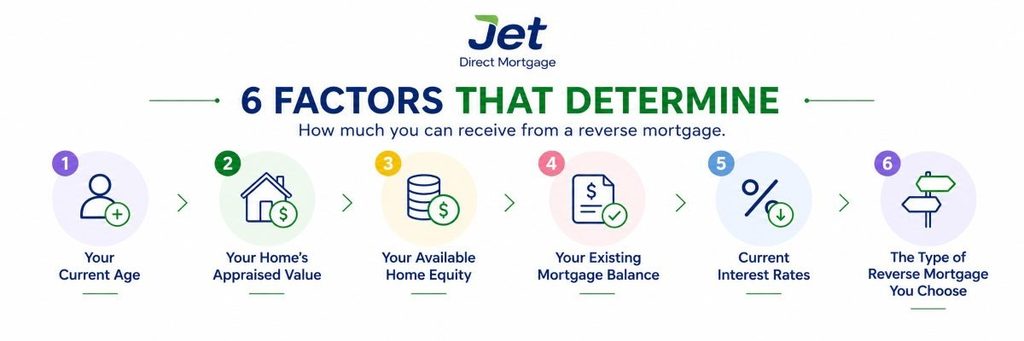
6 Factors That Determine How Much You Can Receive
If two homeowners have identical homes in the same neighborhood, they may still qualify for very different reverse mortgage amounts. That’s because lenders don’t base your loan solely on your home’s value.
Instead, they evaluate several factors that determine your principal limit, the maximum amount you may be eligible to borrow.
Understanding these factors can help you estimate how much you can get from a reverse mortgage in New York and identify which ones have the biggest impact on your available loan proceeds.
1. Your Current Age
Your age is one of the most important factors in determining how much you can receive from a reverse mortgage. For FHA-insured HECM loans, the calculation is based on the youngest borrower listed on the loan. Generally, the older the youngest borrower, the larger the percentage of home equity that can be accessed.
For example, assuming the same home value and expected interest rate:
| Age of Youngest Borrower | Typical Borrowing Percentage* |
| 62 | 35–45% |
| 70 | 40–50% |
| 75 | 45–55% |
| 80 | 50–60% |
| 90 | 60–75% |
2. Your Home’s Appraised Value
The more your home is worth, the more equity you may be able to access. For HECM reverse mortgages, the calculation uses the lower of:
- Your home’s appraised value, or
- The FHA maximum claim amount.
If your home is worth more than the FHA lending limit, you may benefit from a proprietary (jumbo) reverse mortgage, which is specifically designed for higher-value properties and may allow you to access substantially more equity.
However, it’s important to remember that a reverse mortgage does not allow you to borrow 100% of your home’s value. Instead, the home value becomes one part of the overall calculation used to determine your principal limit.
3. Your Available Home Equity
The amount of equity you’ve built in your home plays a major role in how much you can get from a reverse mortgage in New York. Home equity is simply the difference between your home’s current market value and the amount you still owe on any existing mortgage or liens.
For example:
- If your home is worth $600,000 and you owe $50,000, you have $550,000 in equity.
- If your home is worth $600,000 and you owe $350,000, you have $250,000 in equity.
The more equity you have, the more funds may be available through a reverse mortgage. While there is no minimum equity percentage required by FHA, most borrowers qualify when they have at least 50% equity, and many have significantly more.
If you still have a mortgage, don’t worry; you don’t have to pay it off before applying. If you’re approved, the reverse mortgage proceeds are typically used to pay off your existing loan first, with the remaining funds available to you.
4. Your Existing Mortgage Balance
Many homeowners are surprised to learn that you can still qualify for a reverse mortgage even if you haven’t finished paying off your current mortgage. However, the balance you owe has a direct impact on how much you can get from a reverse mortgage in New York.
Here’s a simple example:
| Home Value | Maximum Reverse Mortgage | Existing Mortgage | Available to You* |
| $700,000 | $350,000 | $0 | $350,000 |
| $700,000 | $350,000 | $100,000 | $250,000 |
| $700,000 | $350,000 | $250,000 | $100,000 |
*Illustrative example only. Actual loan proceeds depend on your age, interest rates, loan type, closing costs, and other eligibility factors.
One of the biggest advantages of a reverse mortgage is that it can eliminate your existing monthly mortgage payment.
Before you receive any remaining funds, your current mortgage must typically be paid in full using part of the reverse mortgage proceeds. Whatever remains is then available as a lump sum, monthly payments, a line of credit, or a combination of these options.
5. Current Interest Rates
Interest rates don’t just affect traditional mortgages, they also influence the amount you can borrow with a reverse mortgage.
In general:
- Lower interest rates = Higher borrowing amount
- Higher interest rates = Lower borrowing amount
This happens because lower expected interest rates allow lenders to make a larger percentage of your available home equity accessible through the reverse mortgage. Even if your home’s value and age remain exactly the same, a change in interest rates can increase or decrease your available proceeds.
While you can’t control market rates, understanding their impact can help you better estimate how much you can get from a reverse mortgage in New York and determine whether the timing is right to apply.
6. The Type of Reverse Mortgage You Choose
Not all reverse mortgages work the same way. The loan program you choose can significantly affect how much money you may be able to access. The two most common options are:
| HECM Reverse Mortgage | Proprietary (Jumbo) Reverse Mortgage |
| Insured by the FHA | Offered by private lenders |
| Subject to the FHA maximum claim amount | Designed for higher-value homes |
| Most common reverse mortgage option | May allow access to more equity above FHA lending limits |
| Includes HUD counseling requirements | Loan terms vary by lender |
If your home is worth more than the FHA lending limit, a proprietary reverse mortgage may provide substantially higher borrowing potential. On the other hand, a HECM offers the security of a federally insured program with standardized rules and consumer protections.
Choosing the right loan isn’t just about qualifying, it’s about selecting the program that best aligns with your home’s value, your financial goals, and the amount of equity you hope to access. An experienced reverse mortgage specialist can help you compare both options and determine which one offers the greatest benefit for your situation.
What Are Some Good Reverse Mortgage Examples?
The examples below illustrate how much you can get from a reverse mortgage in New York at different ages. They’re simplified for illustration purposes only. Your actual loan amount will depend on your home’s value, available equity, interest rates, existing mortgage balance, and the reverse mortgage program you choose.
Age 62
If you’re 62 years old and own a home worth $600,000 with little or no remaining mortgage, you may qualify for approximately 35% to 45% of your home’s value, or about $210,000 to $270,000.
Age 70
At 70 years old, the percentage generally increases. Using the same $600,000 home, you may qualify for approximately 40% to 50%, or roughly $240,000 to $300,000.
Age 80
If you’re 80 years old, you may be able to access approximately 50% to 60% of your home’s value. For a $600,000 home, that’s roughly $300,000 to $360,000.
Remember: These are illustrative examples only. Your actual reverse mortgage amount will vary based on your home’s appraised value, available equity, current interest rates, existing mortgage balance, and the loan program you select.
How Can You Receive Your Reverse Mortgage Money?
Once you know how much you can get from a reverse mortgage in New York, the next step is deciding how you’d like to receive your funds. One of the biggest advantages of a reverse mortgage is its flexibility.
Rather than receiving all of the money at once, you can choose the payment option that best fits your financial goals.
The most common options include:
- Lump Sum – Receive all available funds at closing. This option is often used to pay off an existing mortgage, cover large expenses, or make home improvements.
- Monthly Payments – Receive regular monthly payments for a fixed period or for as long as you continue to live in your home, depending on the payment plan you choose.
- Line of Credit – Access funds only when you need them and pay interest only on the amount you’ve borrowed. One unique benefit of a HECM line of credit is that the unused credit line can grow over time, giving you access to more funds in the future. According to the Consumer Financial Protection Bureau (CFPB), this growth feature is one of the key advantages of a HECM line of credit.
- Combination Plan – Combine a line of credit with monthly payments or a smaller lump sum, giving you greater flexibility based on your retirement needs.
The right payment option depends on how you plan to use your home equity. If your goal is to eliminate your current mortgage, a lump sum may make the most sense. If you’re looking to supplement your retirement income or create a financial safety net for unexpected expenses, monthly payments or a growing line of credit may be a better fit.
Can You Increase the Amount You Receive From a Reverse Mortgage?
While you can’t change your age or control interest rates, there are a few ways you may be able to increase how much you can get from a reverse mortgage in New York.
- Pay down your existing mortgage. A smaller mortgage balance leaves more reverse mortgage proceeds available to you.
- Wait until you’ve built more home equity. If your home’s value increases or you continue paying down your mortgage, you may qualify for a larger loan amount.
- Improve your home’s value. Renovations or market appreciation can increase your home’s appraised value, which may increase your available proceeds.
- Explore a proprietary reverse mortgage. If your home exceeds the FHA lending limit, a proprietary (jumbo) reverse mortgage may allow you to access more of your equity than a standard HECM.
Ultimately, the amount you receive is determined by FHA guidelines or proprietary lender requirements. An experienced reverse mortgage specialist can help you compare your options and identify the loan program that provides the greatest borrowing potential for your situation.
How Does My Existing Mortgage Will Affect My Reverse Mortgage?
You don’t have to own your home free and clear to qualify for a reverse mortgage. However, your existing mortgage directly affects how much money you’ll receive.
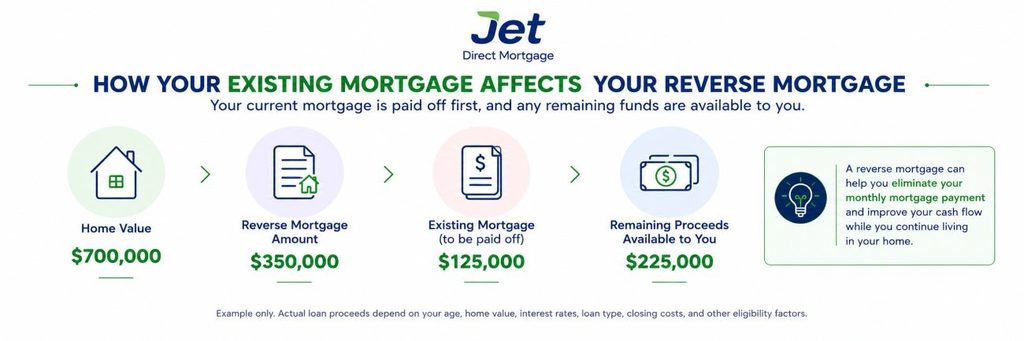
When your reverse mortgage closes, the first use of the loan proceeds is to pay off your current mortgage. Any remaining funds are then available to you as a lump sum, monthly payments, a line of credit, or a combination of these options.
Here’s a simple example:
- Home value: $700,000
- Reverse mortgage amount: $350,000
- Existing mortgage: $125,000
- Remaining proceeds available to you: Approximately $225,000 (before financed closing costs and any applicable set-asides).
If you owe more on your current mortgage, you’ll receive fewer available proceeds. If your mortgage has already been paid off, nearly all of your eligible reverse mortgage funds can be accessed.
For many homeowners, one of the biggest benefits of a reverse mortgage is eliminating their monthly mortgage payment, improving monthly cash flow while allowing them to continue living in their home.
Can You Estimate Your Reverse Mortgage Amount Yourself? (Calculator)
Yes, you can estimate your reverse mortgage amount yourself, but only as an estimate. Your age, home value, available equity, existing mortgage balance, current interest rates, and loan type all affect how much you can get from a reverse mortgage in New York.
The easiest way to estimate your borrowing potential is by using a reverse mortgage calculator.
HECM Reverse Mortgage Calculator
Estimate the funds available from a new adjustable-rate HECM on your current home.
Use your age at your nearest birthday. Borrowers must be at least 62 at closing. 6% is an illustrative assumption, not a current rate quote. Ask your lender for the expected rate used to calculate proceeds; it can differ from the starting interest rate.Spouse, additional debts and cost assumptions
Use ages at the nearest birthday at closing. The youngest applicable age determines the factor. A lender must confirm non-borrowing spouse eligibility. Include second mortgages and outstanding HELOC balances. Do not repeat the mortgage balance entered above. $3,000 is an editable illustration, not a quote. Include applicable appraisal, title, recording, counseling and other closing charges. Exclude origination fees and upfront mortgage insurance, which are calculated separately. Leave blank to use the calculated maximum fee. Enter 0 only if your lender waives it. This estimate assumes all costs and payoffs are financed, with no lender credits or cash contribution.Estimated Net Proceeds
This is an estimate, not a loan offer or eligibility determination. Actual proceeds depend on the appraisal, verified ages, lender pricing, payoff amounts, financial assessment and program requirements. Required reserves for taxes, insurance, servicing or repairs are not included and may reduce proceeds. Fixed-rate, proprietary, purchase and HECM-to-HECM refinance loans are not modeled. First-year access is limited; total net proceeds are not necessarily available immediately. Interest, ongoing mortgage insurance and any servicing charges accrue on the loan and are not deducted here as upfront costs. You remain responsible for property taxes, insurance, maintenance and occupancy requirements.
Calculation sources and assumptions
Uses HUD’s principal limit factors effective for FHA case numbers assigned on or after October 2, 2017, with expected rates rounded to the nearest 0.125 percentage point. Ages above 99 use the age-99 factor. Uses the 2026 HECM maximum claim amount of $1,249,125 and a 2% upfront mortgage insurance premium. The default origination fee is the maximum permitted amount, capped at $6,000; your lender may charge less. Rules last checked September 21, 2026. This calculator does not update automatically.
Want a personalized quote based on current interest rates and your home’s appraised value? Speak with a Jet Direct Mortgage reverse mortgage specialist today.
Is a Reverse Mortgage the Right Choice for You?
A reverse mortgage can be a smart solution if you’re 62 or older, have built substantial equity in your home, and want to improve your cash flow without selling your property. It can help you supplement your retirement income, eliminate your monthly mortgage payment, cover unexpected expenses, or create greater financial flexibility.
However, it’s not the right choice for everyone. Before moving forward, it’s important to understand the costs, responsibilities, and long-term impact on your estate. Speaking with an experienced reverse mortgage specialist can help you determine whether a reverse mortgage in New York aligns with your financial goals.
Find Out How Much You Can Get From a Reverse Mortgage in New York
Knowing how much you can get from a reverse mortgage in New York is the first step toward deciding whether this financing option is right for you.
While the exact amount varies based on your age, home value, available equity, current interest rates, existing mortgage balance, and loan type, understanding how these factors work together gives you a much clearer picture of what you may qualify for.
Whether you’re looking to supplement your retirement income, eliminate your monthly mortgage payment, access funds for home improvements, or simply create greater financial flexibility, a reverse mortgage can unlock a significant portion of your home’s equity while allowing you to continue living in the home you love.
At Jet Direct Mortgage, we’re here to help you understand your options—not pressure you into a decision. If you’re ready to find out how much you can get from a reverse mortgage in New York, contact our experienced team today for a personalized estimate and expert guidance tailored to your financial goals.
FAQ
How much can you get from a reverse mortgage in New York?
The amount you can get from a reverse mortgage in New York depends on your age, your home’s appraised value, available home equity, current interest rates, your existing mortgage balance, and the type of reverse mortgage you choose. Most homeowners qualify to borrow between 40% and 70% of their home’s value, although the exact amount varies. Older borrowers with more equity generally qualify for larger loan amounts.
What percentage of my home’s value can I borrow?
Most reverse mortgage borrowers can typically borrow 40% to 70% of their home’s appraised value. The exact percentage depends on the youngest borrower’s age, current interest rates, available home equity, and whether you choose an FHA-insured HECM or a proprietary reverse mortgage. In general, older homeowners qualify for a higher borrowing percentage.
Does my age affect how much I receive?
Yes. Your age is one of the most important factors in determining how much you can get from a reverse mortgage in New York. The older the youngest borrower, the larger the percentage of home equity you may be eligible to access. This is because reverse mortgage calculations are based on the expected length of the loan.
Does my existing mortgage reduce my reverse mortgage?
Yes. If you have an existing mortgage, it must typically be paid off first using your reverse mortgage proceeds. The remaining funds are then available to you as a lump sum, monthly payments, a line of credit, or a combination of payment options. The higher your current mortgage balance, the less money you’ll receive after closing.
Can I receive a lump sum?
Yes. Most reverse mortgages allow you to receive a lump sum payment, although the amount available depends on the loan program and current FHA rules. Many homeowners choose this option to pay off an existing mortgage, renovate their home, or cover large one-time expenses.
Can I get monthly payments instead?
Yes. Instead of receiving a lump sum, you can choose monthly reverse mortgage payments. Depending on your loan terms, payments can continue for a fixed period or for as long as you live in your home. Many borrowers use this option to supplement their retirement income.
Is the money taxable?
No. Reverse mortgage proceeds are generally not considered taxable income because they are loan proceeds rather than earned income. However, it’s always a good idea to consult a tax professional regarding your specific financial situation.
Can I use a reverse mortgage to pay off my existing mortgage?
Yes. In fact, this is one of the most common reasons homeowners choose a reverse mortgage. At closing, your existing mortgage is typically paid off using part of the reverse mortgage proceeds, eliminating your monthly mortgage payment. Any remaining funds are then available for you to use based on your selected payment option.
What’s the difference between a HECM and a proprietary reverse mortgage?
A HECM (Home Equity Conversion Mortgage) is a reverse mortgage insured by the Federal Housing Administration (FHA) and follows federal lending guidelines. A proprietary reverse mortgage is offered by private lenders and is often designed for higher-value homes that exceed FHA lending limits. Both allow you to convert home equity into cash, but eligibility requirements and borrowing limits differ.
HECM vs. Proprietary Reverse Mortgage: Which Can Provide More Money?
For most homeowners, a proprietary reverse mortgage can provide more money if the home’s value exceeds the FHA maximum claim amount. For homes within FHA lending limits, a HECM is often the preferred option because it offers government-backed consumer protections and standardized loan guidelines. The best choice depends on your home’s value, available equity, and financial goals.
How can I estimate my reverse mortgage amount?
You can estimate how much you can get from a reverse mortgage in New York by using a reverse mortgage calculator. You’ll typically need to enter your age, your home’s estimated value, your current mortgage balance, and your ZIP code. While a calculator provides a useful estimate, only a lender can determine your exact loan amount after reviewing your eligibility, appraisal, current interest rates, and loan program.

Experienced Chief Operating Officer with a 26 + year demonstrated history of working in the banking industry. Skilled in all aspects of the residential mortgage market . Strong business development professional with a Bachelor of Science (BS) focused in Business Administration and Management, from St. Joseph College. A direct endorsement underwriter and a licensed Mortgage Loan Originator.