Wondering if you qualify? Learn the reverse mortgage requirements in New York, including age, equity, eligible properties, financial assessment, and more.
If you’re considering a reverse mortgage in New York in 2027, one of the first questions you’re probably asking is, “Do I qualify?” The good news is that qualifying for a reverse mortgage isn’t based on your income alone like a traditional mortgage. Instead, lenders look at factors such as your age, your home’s equity, the type of property you own, and your ability to meet certain financial obligations.
Understanding the reverse mortgage requirements in New York before you apply can save you time, help you set realistic expectations, and make the application process much smoother.
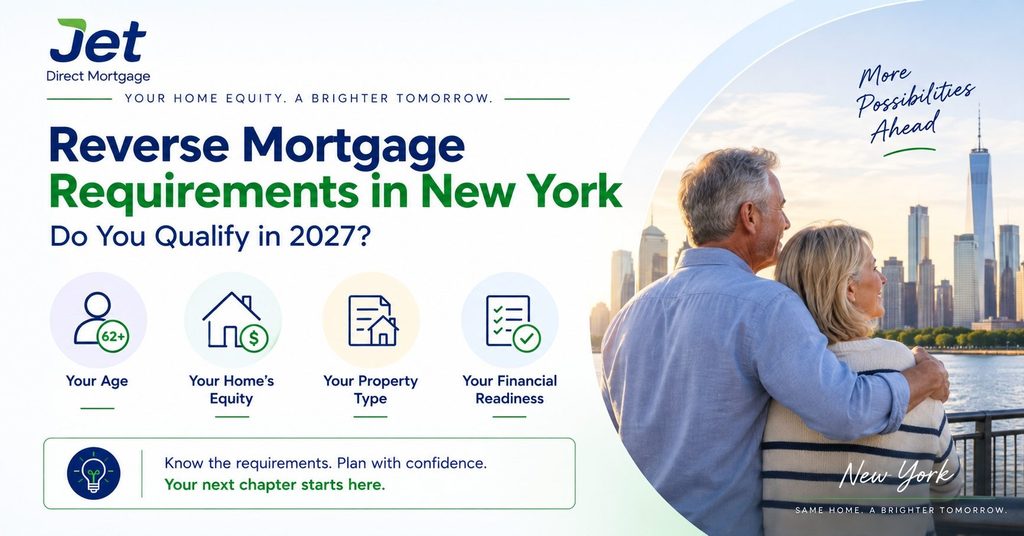
Whether you’re hoping to supplement your retirement income, eliminate your monthly mortgage payment, or access the equity you’ve built over the years, knowing the eligibility requirements is the first step.
In this guide, we’ll walk you through the reverse mortgage requirements in New York for 2027, explain who qualifies, what lenders look for, and the most common reasons homeowners are approved (or denied) so you can determine whether a reverse mortgage is the right fit for your financial goals.
What Are the Reverse Mortgage Requirements in New York in 2027?
To qualify for a reverse mortgage in New York, you must meet several eligibility requirements established by the Federal Housing Administration (FHA) for HECM loans or by the lender for proprietary reverse mortgages.
While specific guidelines vary by loan program, most borrowers must meet the following requirements:
- Be at least 62 years old (for FHA-insured HECM loans)
- Own your home and have sufficient equity
- Live in the home as your primary residence
- Own an eligible property
- Pass a financial assessment
- Complete HUD-approved reverse mortgage counseling before closing
Meeting these basic reverse mortgage requirements in New York doesn’t automatically guarantee approval, but it does mean you may be eligible to apply. In the following sections, we’ll explain each requirement in detail, including how lenders evaluate your eligibility and the most common reasons homeowners qualify, or don’t.
Top 6 Reverse Mortgage Requirements in New York
1. You Must Meet the Minimum Age Requirement
One of the first reverse mortgage requirements in New York is meeting the minimum age requirement. For an FHA-insured Home Equity Conversion Mortgage (HECM), the youngest borrower must be at least 62 years old at the time of closing.
This age requirement is established by the U.S. Department of Housing and Urban Development (HUD) and applies nationwide.
Age isn’t just used to determine whether you qualify, it also affects how much you may be eligible to borrow. Reverse mortgages are designed to be repaid when the home is sold or is no longer your primary residence.
Because older borrowers generally have a shorter projected loan term, they can typically access a larger percentage of their home’s equity than younger borrowers. This is why a 75-year-old homeowner may qualify for a higher loan amount than a 62-year-old with the same home value and equity.
If there is more than one borrower, lenders use the age of the youngest borrower when calculating the available loan amount. This protects both borrowers and ensures the loan remains sustainable throughout the life of the mortgage.
If one spouse is under 62, you may still have options. Depending on the loan program, the younger spouse may qualify as an eligible non-borrowing spouse, allowing them to remain in the home under certain conditions if the borrowing spouse passes away or permanently leaves the property.
Some proprietary reverse mortgages offered by private lenders may also have different minimum age requirements, although HECMs require borrowers to be at least 62.
Quick Summary
- Minimum age for a HECM: 62 years old
- The youngest borrower’s age determines both eligibility and loan calculations
- Older borrowers generally qualify for larger loan amounts
- Some proprietary reverse mortgages may have different age requirements
- A younger spouse may qualify as an eligible non-borrowing spouse under HECM rules
Can this disqualify you?
✓ Yes. If the youngest HECM borrower is under 62, you won’t qualify for an FHA-insured reverse mortgage. However, you may still have options through certain proprietary reverse mortgage programs.
2. You Need Sufficient Home Equity
Having enough home equity is another essential reverse mortgage requirement in New York. Because a reverse mortgage allows you to borrow against the value of your home, the more equity you’ve built, the more you may be eligible to receive.
While the FHA doesn’t require a specific equity percentage, most homeowners who qualify have at least 50% equity in their home. If you’ve already paid off your mortgage, or only have a small balance remaining, you’ll typically have more borrowing power than someone who still owes a significant portion of their loan.
According to the Consumer Financial Protection Bureau (CFPB), any existing mortgage must generally be paid off using the reverse mortgage proceeds before you can access the remaining funds.
Home equity is calculated using a simple formula:
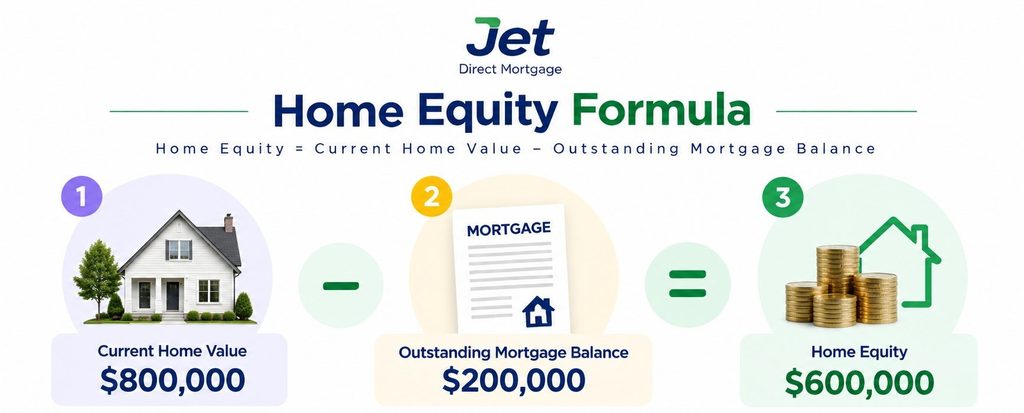
For example:
- Home value: $800,000
- Mortgage balance: $200,000
- Available equity: $600,000
Keep in mind that having $600,000 in equity doesn’t mean you’ll receive $600,000 from a reverse mortgage. Your available loan amount is also based on your age, current interest rates, and the type of reverse mortgage you choose. Most borrowers qualify to access approximately 40% to 70% of their home’s value, depending on these factors.
Can This Disqualify You?
✓ Yes. If you don’t have enough home equity to pay off your existing mortgage and still meet the lender’s eligibility requirements, you may not qualify for a reverse mortgage. Building more equity over time or reducing your mortgage balance may improve your eligibility.
3. Your Home Must Be Your Primary Residence
Another important reverse mortgage requirement in New York is that the home must be your primary residence. In other words, it must be the home where you live for the majority of the year. Vacation homes, second homes, and most investment properties are not eligible for an FHA-insured Home Equity Conversion Mortgage (HECM).
As a general rule, you must continue living in the property for more than six months each year. Temporary absences for travel or medical treatment are typically permitted. If you’re away because of a physical or mental illness, you can generally remain absent for up to 12 consecutive months before the loan becomes due and payable.
This requirement doesn’t end after closing. Throughout the life of the loan, you’ll need to continue using the property as your primary residence while staying current on property taxes, homeowners insurance, and any applicable HOA fees. Failing to meet these ongoing obligations could cause the loan to become due.
| Property | Eligible for a HECM? |
| Your primary residence | Yes |
| Vacation home | No |
| Rental or investment property | No |
| Second home | No |
Can This Disqualify You?
✓ Yes. If the property isn’t your primary residence, you won’t qualify for an FHA-insured reverse mortgage. If you’re purchasing a new home with a HECM for Purchase, you’ll also need to make that property your primary residence after closing.
4. Your Property Must Qualify
Meeting the borrower requirements isn’t enough, your home must also qualify. The FHA only insures reverse mortgages on certain property types that meet its eligibility standards. In addition to being your primary residence, the property must generally be in good condition and comply with FHA property requirements.
The most common property types that qualify for a HECM reverse mortgage include:
| Property Type | Eligible? |
| Single-family home | Yes |
| 2–4 unit property (you occupy one unit) | Yes |
| FHA-approved condominium | Yes |
| Eligible manufactured home | Yes |
| Vacation or second home | No |
| Investment or rental property | No |
| Cooperative (co-op) | Not for FHA HECMs* |
*Some proprietary reverse mortgage programs may offer financing for certain New York co-ops, but they aren’t eligible under the standard FHA HECM program.
Even if your property falls into an eligible category, it must still satisfy FHA appraisal and property standards. For example, the home must be safe, structurally sound, and marketable. If significant repairs are needed, they may need to be completed before, or sometimes with, the reverse mortgage proceeds.
Can This Disqualify You?
✓ Yes. If your home isn’t an eligible property type or doesn’t meet FHA property standards, you won’t qualify for an FHA-insured reverse mortgage. However, depending on the property and its value, a proprietary reverse mortgage may still be an option worth exploring.
5. You Must Pass the Financial Assessment
One of the most important reverse mortgage requirements in New York is the financial assessment. Contrary to popular belief, you don’t need a high income or a perfect credit score to qualify for a reverse mortgage.
However, lenders must determine that you’re financially able to meet the ongoing responsibilities of homeownership. This requirement was introduced by the FHA to help reduce future loan defaults and ensure borrowers can remain in their homes.
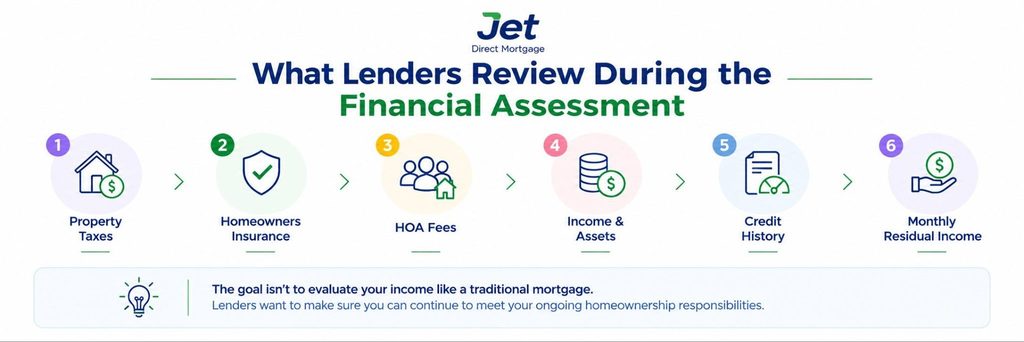
During the financial assessment, your lender will review factors such as:
- Your history of paying property taxes
- Your homeowners insurance payment history
- Any HOA or condominium fees
- Your income, assets, and monthly expenses
- Your credit history and any delinquent federal debt
- Your residual income after paying your monthly obligations
It’s important to understand that there is no minimum credit score required for an FHA-insured HECM. Instead, the focus is on whether you’re likely to continue paying your property charges and maintaining your home after the loan closes.
Even borrowers with past credit challenges may still qualify if they can demonstrate the ability to meet these ongoing obligations.
If the lender determines there is a higher risk that future property taxes or insurance may not be paid, you may still be approved. In some cases, part of your reverse mortgage proceeds are placed into a Life Expectancy Set-Aside (LESA), which is used to pay future property taxes, homeowners insurance, and other required property charges on your behalf.
Can This Disqualify You?
✓ Yes. If the financial assessment shows that you won’t be able to meet your ongoing obligations, and a LESA isn’t sufficient to address the risk, you may not qualify for a reverse mortgage. The goal isn’t to evaluate your income like a traditional mortgage, but to ensure you can continue paying property taxes, insurance, HOA fees, and maintaining your home throughout the life of the loan.
6. You Must Complete HUD-Approved Reverse Mortgage Counseling
One of the final reverse mortgage requirements in New York in 2027 is completing HUD-approved reverse mortgage counseling.
If you’re applying for an FHA-insured Home Equity Conversion Mortgage (HECM), this step is required by law before your loan can move forward. The purpose isn’t to sell you a reverse mortgage, it’s to make sure you fully understand how the loan works and whether it’s the right choice for your financial situation. During the counseling session, an independent HUD-approved counselor will explain:
- How a reverse mortgage works
- Your responsibilities as a homeowner
- Loan costs and repayment rules
- Alternatives to a reverse mortgage
- The impact on your heirs and estate
The counselor cannot recommend a specific lender or pressure you to move forward. Their role is to provide objective information so you can make an informed decision. After completing the session, you’ll receive a Certificate of HECM Counseling, which your lender will need before processing your application.
Counseling is typically completed by phone or video, although in-person sessions may also be available through HUD-approved counseling agencies. You can find an approved counselor using HUD’s online HECM Counselor Roster or by calling HUD’s housing counseling hotline.
Can This Disqualify You?
✓ Yes. If you don’t complete HUD-approved counseling, you cannot obtain an FHA-insured HECM reverse mortgage. Completing counseling doesn’t guarantee loan approval, but it is a mandatory step in the application process.
Are There Any Reverse Mortgage Requirements That Are Unique to New York?
Yes, in addition to the federal requirements for FHA-insured HECM loans, homeowners must also comply with certain reverse mortgage requirements in New York.
The state has adopted additional consumer protection laws designed to help borrowers better understand the loan, compare their options, and avoid surprises during the application process.
Some of the key New York-specific requirements and protections include:
- Additional consumer disclosures. Before closing, lenders must provide detailed information about your loan terms, costs, repayment obligations, and events that could cause the loan to become due.
- Counseling requirements. HECM borrowers must complete HUD-approved counseling before closing. Proprietary reverse mortgages in New York are also subject to state counseling requirements, although the rules differ slightly depending on the loan type.
- Three-day cancellation period. New York law gives borrowers the right to cancel a reverse mortgage commitment within three business days after signing it, providing additional time to reconsider their decision.
- Notices before default or foreclosure. If an event occurs that could place your reverse mortgage in default, New York regulations require lenders to provide written notice and explain the steps needed to resolve the issue before moving forward with foreclosure.
- Expanded proprietary reverse mortgage options. Unlike many states, New York permits proprietary reverse mortgages, including products for certain cooperative apartments (co-ops) that are not eligible under the standard FHA HECM program.
These additional protections are one reason many homeowners feel more confident exploring a reverse mortgage in New York. They help ensure you receive clear information, understand your rights, and have time to make an informed financial decision before committing to the loan.
Can This Disqualify You?
Not usually. These rules are primarily designed to protect you rather than create additional barriers to qualification. However, failing to complete any required counseling or refusing to provide the necessary documentation may delay or prevent your loan from closing.
What Can Disqualify You From Getting a Reverse Mortgage?
Meeting most of the reverse mortgage requirements in New York in 2027 doesn’t always guarantee approval. If one or more eligibility requirements aren’t met, your application may be denied or delayed until the issue is resolved.
Some of the most common reasons homeowners don’t qualify include:
- You’re under 62 years old for an FHA-insured HECM.
- Your home isn’t your primary residence.
- You don’t have enough home equity to support the loan.
- Your property isn’t eligible under FHA guidelines.
- You don’t pass the financial assessment, and a Life Expectancy Set-Aside (LESA) isn’t sufficient.
- You don’t complete the required HUD-approved counseling.
- You have unresolved federal debt or fail to provide the required documentation during the application process.
The good news is that many of these issues can be resolved. For example, paying down your existing mortgage, building more equity, correcting documentation, or choosing a proprietary reverse mortgage instead of a HECM may improve your eligibility depending on your situation.
That’s why it’s worth speaking with an experienced reverse mortgage specialist before assuming you don’t qualify.
Quick Tip
Being denied for one reverse mortgage program doesn’t necessarily mean you won’t qualify for another. Some proprietary reverse mortgage products have different eligibility guidelines than FHA-insured HECMs, particularly for higher-value homes or certain New York property types.
Ready to Find Out If You Qualify?
Understanding the reverse mortgage requirements in New York is the first step toward making an informed financial decision.
While every homeowner’s situation is different, meeting the basic eligibility requirements, including age, home equity, property type, financial assessment, and HUD counseling, may qualify you to convert a portion of your home’s equity into tax-free loan proceeds while continuing to live in your home.
If you’re still unsure whether you qualify, you don’t have to figure it out alone. At Jet Direct Mortgage, our experienced reverse mortgage specialists can review your situation, answer your questions, and explain your options with no pressure or obligation.
Ready to see if you qualify? Contact Jet Direct Mortgage today for a personalized reverse mortgage consultation and discover whether a reverse mortgage is the right fit for your retirement goals.
Frequently Asked Questions
What are the reverse mortgage requirements in New York?
To qualify for a reverse mortgage in New York, you generally must be at least 62 years old (for a HECM), live in the home as your primary residence, have sufficient home equity, own an eligible property, pass a financial assessment, and complete HUD-approved counseling before closing. Additional New York consumer protection rules may also apply.
How much equity do I need for a reverse mortgage?
There is no FHA minimum equity percentage, but most borrowers have at least 50% home equity. The more equity you have, the more you may be eligible to borrow, although your age, interest rates, and loan type also affect your available loan amount.
Can I get a reverse mortgage if I still have a mortgage?
Yes. You can still qualify if you have an existing mortgage, provided it can be paid off using the reverse mortgage proceeds or your own funds at closing. Any remaining proceeds are then available to you based on your selected payment option.
Do I need good credit to qualify for a reverse mortgage?
Not necessarily. There is no minimum credit score for an FHA-insured HECM. Instead, lenders perform a financial assessment to determine whether you’re able to continue paying property taxes, homeowners insurance, HOA fees, and other required property expenses.
Is there an income requirement for a reverse mortgage?
Unlike a traditional mortgage, reverse mortgages don’t have a minimum income requirement. However, lenders must verify that you have sufficient financial resources to meet your ongoing homeownership obligations after the loan closes.
Can I get a reverse mortgage on a condo in New York?
Yes. You may qualify if your condominium is FHA-approved for a HECM. If it isn’t FHA-approved, some proprietary reverse mortgage programs may still be available depending on the lender and the property.
Can I get a reverse mortgage on a co-op in New York?
A standard FHA-insured HECM cannot be used for most co-ops because you don’t own the real estate directly. However, some private lenders offer proprietary reverse mortgages specifically designed for eligible New York cooperative apartments.
Is HUD counseling required before getting a reverse mortgage?
Yes. If you’re applying for an FHA-insured HECM, you must complete counseling with a HUD-approved housing counselor before your loan can close. The session explains how reverse mortgages work, your responsibilities as a borrower, the costs involved, and possible alternatives.
Can I be denied a reverse mortgage?
Yes. You may be denied if you don’t meet the age requirement, lack sufficient home equity, don’t live in the property as your primary residence, own an ineligible property, fail the financial assessment, or don’t complete the required counseling.
What happens if I don’t pay my property taxes or homeowners insurance?
Even after receiving a reverse mortgage, you’re responsible for paying property taxes, homeowners insurance, and any applicable HOA fees, as well as maintaining your home. Failing to meet these obligations can place the loan in default and may eventually lead to foreclosure.
What happens to my reverse mortgage if I move out of my home?
A reverse mortgage generally becomes due when the home is no longer your primary residence. This may happen if you sell the home, permanently move to another residence, or live in a healthcare facility for more than the allowed period under your loan terms.
Do I still own my home if I get a reverse mortgage?
Yes. With a reverse mortgage, you remain the owner of your home and your name stays on the title. As long as you continue living in the home as your primary residence and meet your loan obligations, you retain ownership just as you would with a traditional mortgage.

Experienced Chief Operating Officer with a 26 + year demonstrated history of working in the banking industry. Skilled in all aspects of the residential mortgage market . Strong business development professional with a Bachelor of Science (BS) focused in Business Administration and Management, from St. Joseph College. A direct endorsement underwriter and a licensed Mortgage Loan Originator.